Showing posts with label DOOM. Show all posts

Friday, October 21, 2016

News & Views
10/15/16-10/21/16

News & Views collects the week’s best writing about video games and compiles them into one convenient place. Check out the links below for stories about a level that took 300 hours to make, how consoles are compromising their ‘play now’ identity, a core failure of military shooter video games, and why is it is difficult to make a video game.

And of course please check out the brand new episode of The Impact Factor podcast that was posted today! You can subscribe to the podcast on iTunes, or if you prefer other methods, check out our SoundCloud. We’re on YouTube too!

Spotlight
Tina Amini, Waypoint

Worth Reading
Mark Brown, Boss Keys

Jim Trinca, Waypoint

Jeffrey Matulef, Eurogamer

Matthew Walden, Rolling Stone

Jim Sterling, The Jimquisition

Steven Messner, PC Gamer

Dan Hill, Kill Screen

Ryan Bradley, Longreads

Friday, August 5, 2016

News & Views
7/30/16-8/5/16

Summer Games are afoot. Rio’s opening ceremony airs tonight and Lucioball is talking folks by storm in Overwatch. While you wait, why not sit down to read a few pieces of great gaming writing?

News & Views collects the week’s best writing about video games and puts it into one convenient place. Check out the links below for stories about the relationship between goats and DOOM, the insane fan culture that’s arisen around No Man’s Sky, and the less than stellar race politics of the new Deus Ex game.

And of course please check out the brand new episode of The Impact Factor podcast that was posted today! You can subscribe to the podcast on iTunes, or if you prefer other methods, check out our SoundCloud. We’re on YouTube too!

Spotlight
Patrick Stafford, Polygon

Worth Reading
Austin Walker, VICE

Patrick Klepek, Kotaku

Maddi Chilton, Kill Screen

Reid McCarter, Kill Screen

Mantin Lu, Gamasutra

With Comments
Matt Sayer, Unwinnable
As a long time Souls fan I’ve long wondered if there was a way to make the games more accessible without compromising their unrivaled design. The answer to my own question was typically a resounding no. Matt Sayer also investigates this question. He provides some possible avenues to consider: like directing the player to focus their attack on a specific part of the boss via glowing limbs, or warnings for players about to fall to their deaths. I like what he’s trying here, but disagree that these would work. More thought is needed.

Emeric Thoa, Gamasutra
I quite enjoyed Furi. I really appreciated how dedicated that game was to its core principles, for better and worse. Emeric Thoa, one of the game’s designers, writes about their philosophy for the game. Of the most interesting aspects is The Game Bakers’ goal to make a ‘triple I’ game. It centers around the idea that you cannot compete with AAAs in terms of scope, so you must focus on one feature and make it exceptional. This will help your game stand out among indies. Thoa also writes about how, in doing so, you cannot worry about alienating a large audience—you can’t please everyone. 

Tuesday, August 2, 2016

One Hell Of A Good Time
Review
DOOM, id Software (PS4)

Abstract: DOOM (2016) is a perfect blend of old and new, bringing players back to the way we used to play first-person shooters while smartly adapting and incorporating 20+ years of design insight along the way. DOOM is fast and frantic, bloody and brutal, and has some of the tightest designed gameplay I’ve seen all year. Glory Kills change the way you play, reinforcing DOOM’s themes and solving a long-entrenched issue in first-person shooters. Great gunplay and rewarding exploration form a strong gameplay loop that keeps players engaged through DOOM’s admittedly weak story. A few poorly designed encounters and underwhelming bosses detract from the experience, but DOOM is very much worth playing. It’s one hell of a good time.

For video game enthusiasts my age, the original Doom was groundbreaking. It redefined how I understood video games. Whether it was staying up late to play or booting it up when the computer lab teacher stepped out of the room, Doom was on the forefront of my gaming brain from a very early age. Simply put, there had never been anything quite like it. Doom was dark, gritty and violent during a time most of my gaming time was spent in “edutainment” titles. Doom was fast, almost incomprehensibly so, at a time games were often sluggish. Doom felt deeply complex, with secrets cleverly hidden around every corner, weapons to find, and strategies you had to enact on the fly to defeat some of the game’s tougher demons. Doom was the future.

Over time the rest of the world caught up. Doom’s formula was tweaked and adapted in a variety of ways in a variety of games. Doom followed up with a spectacular sequel, but then it all sort of dropped off. Released in 2004, Doom 3 was an underwhelming, slow, resource-oriented survival horror game. And then there was nothing. That is, until DOOM (2016) released. Could a very different id Software return to the long dormant IP to do something exciting? Could it recapture the magic of the first two titles? For the most part, that answer is a resounding yes.

DOOM starts as the player is pulled from a coffin into a blood-soaked room. The Doom Marine makes short work of the handful of demons guarding his place of slumber. You know in an instant that this is not, and will not be, a survival horror game. You’re the Doom Marine, you’re a force to be reckoned with, and demons should be scared. A quick stroll over to some conveniently placed armor (called a Praetor Suit), and you’re off to learn who you are, where you are, and what needs to be done. You quickly discover that you’re on Mars in a facility that was designed to mine “argent energy” directly from Hell. Things went awry, as they always do, allowing Hell’s demons to kill, mutilate, or possess the majority of the facility’s personnel. The story beats throughout your journey are well-tread ground for first- and third-person shooter games. You need to get from A to B but the power is off, so go find and flip a switch. You need to gain access to some remote terminal. And so on. The game’s story takes you through the majority of the facility and into Hell itself. The narrative framework is weak—just enough to keep the player moving in the right direction and mostly aware of what he or she is doing. For most games, a story this poor would be a major negative. Not for DOOM though. DOOM is about killin’ demons.

I'm here to kill demons and chew bubble gu...
Wait wrong game.
Gameplay is king. As you might expect, the majority of your playtime is spent blowing away demons. The gunplay is so satisfyingly designed. DOOM eschews the conventions that so many modern first-person shooters adhere to. Your health doesn’t regenerate. The majority of your weapons cannot be aimed down the sights. Ammo, armor, health packs, and even weapons can be found strewn around the map. And DOOM is fast. Intensely fast. The Doom Marine zips around at breakneck speeds and demons move just as fast. Mobility is emphasized in all regards. In many ways, so much of what I described is a throwback to the first-person shooters of times past. DOOM (2016) plays more similarly to Doom than any shooter I’ve played in years. It’s refreshing. That’s not to say DOOM hasn’t learned from the 20+ years of development insight since Doom II released. It adapts systems that work within its old-is-new context. Your Praetor suit, for example, can be powered up by collecting points from downed marines around the map. Argent energy points can be used to level up your health, armor, and ammo totals. You can also find, equip, and level up runes that boost particular stats. DOOM smartly adapts the player progression systems of modern titles into its fast, frantic old-school gameplay experience.

Old-school never felt so new. And so fun.
Your speed is complemented by DOOM’s array of fantastic weapons. Killing demons is an absolute joy. No two guns are alike, though each is viable and allows for different approaches to butchering the agents of evil. Weapons look and sound powerful. My go-to setup was the infamous Super Shotgun and the slow but devastating Gauss Cannon. Like your suit, guns too can be leveled up and customized, each having two separate modifications that add alternate firing methods. DOOM rewards you for trying new things and gives players the tools to play however they like. As you explore you’ll find a handful of demons along your way—small packs that can be quickly dispatched. Other encounters are more entrenched, in which you come upon a set location with waves of demons that will spawn in to attack. This dynamic creates a compelling gameplay loop of explore, kill, entrench, kill, repeat. And the loop is always, always fun. From a raw gameplay perspective, DOOM easily ranks among the top of games released this year.

Adding to that is the ingenious “Glory Kill” system. So many first-person shooters lack momentum. They often devolve into boring shooting galleries. And why is that the case (bad encounter design aside)? Health. In a game like Call of Duty, a lot of your time is spent hiding behind cover as your health slowly regenerates. You take damage because you want to be aggressive, but you can’t sustain your aggression because you’ll die. DOOM fixes this problem in the most Doom-like way possible. As stated earlier, your health does not regenerate. But DOOM doesn’t want you running away from battle to look for health packs. No way. Enter the Glory Kill. When a demon takes enough damage they’ll start to flash blue/orange. If you melee (R3 on PS4) a flashing demon you get a Glory Kill. Glory Kills are brutally animated finishing attacks, like crushing the demon’s head between your hands or ripping off the demon’s arm and smacking him with it. Any demon finished off by a Glory Kill will drop health and ammo. That means that, when your health is low, DOOM encourages you to not only stay in the fight but to get right up in a demon’s face. It maintains the fast and frantic pace of DOOM’s gunplay, adds to the already effective power fantasy, and solves one of my biggest issues with first-person shooter campaigns. Win win win.

Glory Kills are a smart, gory solution to one of first-person shooter's
biggest problems.
Playing through DOOM’s campaign is a linear experience, but one that is ripe with exploration. The game is separated into 13 distinct levels. Each level is a sprawling map, open to the player to be explored in any way they see fit. You can run directly to the marked objectives or run the opposite way in search of hidden secrets. Speaking of secrets, there are plenty. A thorough scouring of the map will have the player come across extra Praetor points, new weapon mods, argent energy reserves, miniature “Doom Guy” dolls, and even classic Doom maps. Levels are absolutely packed with secrets and collectibles, and I felt compelled to discover each and every one. Finding them isn’t always so easy, though, as one quick glance at the in-game map will show you. DOOM’s levels are mazelike, weaving and intersecting in ways that demand a good sense of geography to fully grasp.
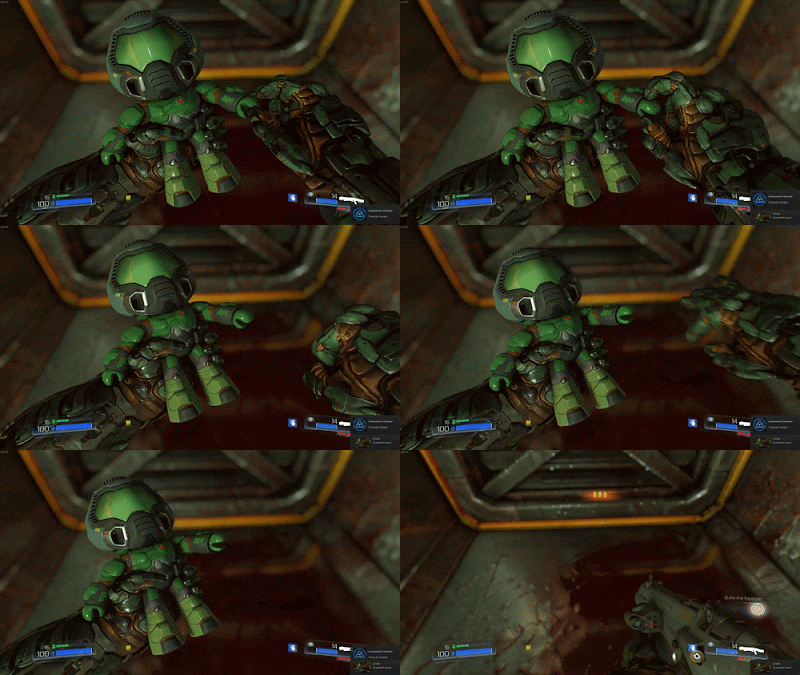
Hey little buddy. DOOM pushes you to collect 'em all.
PS: Try dying in lava. You won't regret it.
While I mostly enjoyed the large map size, it did pose a few gameplay problems. Getting around these large maps, especially when on the hunt for collectibles, can take quite a while and involve a lot of backtracking. This wouldn’t be a huge issue if not for how valuable some of these collectibles are. Without thoroughly searching the map, the player cannot fully upgrade their weapons, suit, or character by the game’s end. On the “Hurt Me Plenty” difficulty I never had too tough a time killing my foes, but I also maxed out my character whenever I could. For less experienced players or on harder difficulties, the reliance on finding secret items to fully power up your Doom Marine could pose a problem. Further, poor map design in a few of the entrenched encounters I described earlier was a bummer. Verticality is a key feature for these encounters, but I found several instances in which there was simply too much. Several common demons are fond of running away from the player, and when a map is too large and too vertical, it can be hard to chase them down. The result is a frustrating game of cat and mouse that drags these encounters down. And speaking of underwhelming encounters, DOOM features a small handful of bosses and none of which are particularly exciting or memorable. The final boss, for example, was laughably easy and felt like a strange note to end on for an otherwise extraordinary experience.

I cannot properly review DOOM without mentioning how absolutely stunning its visuals are. DOOM is a gorgeous game. Id Software blew me away with how crisp and detailed everything is, from guns to demons to environments. Despite lacking in geographic diversity, I loved looking at the different Mars facilities, the planet, and the handful of Hell zones I was taken to. The visuals are complemented by a gritty metal soundtrack that perfectly kicks in during heated battles. When I find myself stopping to admire the scenery and take screenshots, I know a game nails its presentation.

She's a looker alright.
At the year’s start, I had little to no interest in playing DOOM. How could it encapsulate that perfect “Doom” experience in modern setting? I am so happy to be proven wrong. Id Software made a fantastic hybrid of old and new that touts some of 2016’s best raw gameplay. My experience hasn’t really stuck with me, and I’m not too sure why, but it does not change the fact that I had one hell of a good time playing through DOOM.

DOOM
4/5

Friday, July 29, 2016

The Impact Factor Ep. 65: ResidentSleeper aka Wormhole Boys
Podcast
Welcome to the 65th episode of The Impact Factor! The Impact Factor is what happens when two scientists, and two best friends, get together to talk about video games. Hosts Alex Samocha [biomedical scientist] and Charles Fliss [social scientist] sit down every week to discuss the week in gaming! Listen in for the news, views, and games that made the biggest impact!

Please send your suggestions and feedback to: impactfactorpodcast@gmail.com

In this episode Alex and Fliss talk about SDCC, eSports, Overwatch, Injustice 2, Nintendo NX, Sonic the Hedgehog, Telltale’s Batman, The International 2016, video game sequels, DOOM, Street Fighter V story mode, Blair Witch and much more!

"How I learned to stop worrying and love video game sequels" Josh Bycer, Gamasutra


YouTube page

For articles and reviews from Alex, check out: www.theimpactfactor.blogspot.com
For a blog about Japan, pop culture & more from Fliss, check out:

Follow Alex @alexsamocha on Twitter. twitch.tv/megalodonphd
Follow Fliss 
@thecfliss on Twitter. twitch.tv/flissofthenorthstar

Intro song:
You Kill My Brother by Go! Go! Go! Micro Invasion, East Jakarta Chiptunes Compilations. Freemusic Archive. (Attribution Noncommercial Share-Alike License)
Transitions:
News & Views and Perspectives transitions from victorcenusa, Freesound.org (Creative Commons 0 License)
Experimental Methods transition from Sentuniman, Freesound.org (Attribution Noncommercial License)

Monday, July 25, 2016

TIF Plays: Week of 7/18-7/22
Gameplay

Welcome to the The Impact Factor's last week of gameplay! Check out below to links of all my gameplay. Be sure to catch me live on Twitch (MegalodonPhD). I stream every Tuesday and Thursday at 5:30pm PT. Plus some special Friday streams, too! You can do me a favor by subscribing to The Impact Factor's YouTube channel, but hey, don't let me tell you what to do! 

To keep up to date with everything The Impact Factor, and me, follow me on Twitter: @alexsamocha

See you all next week!


Friday, July 22, 2016

News & Views
7/16/16-7/22/16

And that does it for another crazy July week. My heart isn’t at full strength today given all of the ugliness that’s come out of the RNC, but I digress—nothing stops the quality Impact Factor content from flowing!

News & Views collects the week’s best video game writing into one place. Check out the links below for stories about DOOM’s powerful gamedev tools, ageism in the video game industry, and life after your game has failed on one of the world’s biggest platforms.

And of course please check out the brand new episode of The Impact Factor podcast that was posted today! You can subscribe to the podcast on iTunes, or if you prefer other methods, check out our SoundCloud. We’re on YouTube too!

Spotlight
Jeremy Parish, US Gamer

Worth Reading
Bec McKenzie, Deorbital

Bo Moore, Gamasutra

David Mullich, Gamasutra

Gabby DaRienzo, Medium

Nathan Grayson, Kotaku

With Comments
Matt Sayer, Unwinnable
I watched DOOM’s credits roll this morning. Matt Sayer puts it well – the credits are definitely a cut above the rest. As I assume most people do, I try my very best to make it through to the end of a game’s credits. Indies are easy. AAA’s are another story entirely. Adding apt visual appeal and interactivity is a great way to have more people see the names of the folks who’ve poured themselves into making the game a reality. Good on ya, DOOM.

Reed Underwood, Kill Screen
Reed Underwood’s piece on Kill Screen really spoke to me. Even as few as six years ago, I was an unabashed skeptic of watching video games. Twitch, while intriguing, baffled me. Why would anyone sit down and watch someone play for 5 hours straight?! But then, suddenly, it clicked. Watching games offers so much: viewiing players of exception skills, time capsule competitive events, and personality-based entertainment. To the last point, it’s like when you were a kid hanging out in your friends basement, only the controller never gets passed to you. It’s community, it’s friendship, and its conversation. What’s not to like?

Alexander Kriss, Kill Screen
Valkyria Chronicles is a game I’ve been meaning to get to for nearly a decade. This turn-based strategy RPG explores themes of war and the people who wage it. The game has been long praised for its battle systems and world, but only recently have I been made aware the quality of the narrative. Valkyria Chronicles, as Alexander Kriss writes, is not about right vs. wrong or good vs. evil, but person vs. person and ideology vs. ideology. My favorite part of this article: “If dehumanization is a means to wage war simplification is a means to rationalize it.” Very well said. Give this one a read.
The Impact Factor Ep. 64: Download. Complete.
Podcast
Welcome to the 64th episode of The Impact Factor! The Impact Factor is what happens when two scientists, and two best friends, get together to talk about video games. Hosts Alex Samocha [biomedical scientist] and Charles Fliss [social scientist] sit down every week to discuss the week in gaming! Listen in for the news, views, and games that made the biggest impact!

Please send your suggestions and feedback to: impactfactorpodcast@gmail.com

In this episode Alex and Fliss talk about EVO 2016, Street Fighter V, LI Joe, Pokemon GO, ABZU, Bound, Life is Strange, Tomb Raider, Duck Hunt, DDR, Rock Band, DOOM and much more!


YouTube page

For articles and reviews from Alex, check out: www.theimpactfactor.blogspot.com
For a blog about Japan, pop culture & more from Fliss, check out:

Follow Alex @alexsamocha on Twitter. twitch.tv/megalodonphd
Follow Fliss 
@thecfliss on Twitter. twitch.tv/flissofthenorthstar

Intro song:
You Kill My Brother by Go! Go! Go! Micro Invasion, East Jakarta Chiptunes Compilations. Freemusic Archive. (Attribution Noncommercial Share-Alike License)
Transitions:
News & Views and Perspectives transitions from victorcenusa, Freesound.org (Creative Commons 0 License)
Experimental Methods transition from Sentuniman, Freesound.org (Attribution Noncommercial License)

Monday, July 18, 2016

TIF Plays: Week of 7/11-7/15
Gameplay

Welcome to the The Impact Factor's last week of gameplay! Check out below to links of all my gameplay. Be sure to catch me live on Twitch (MegalodonPhD). I stream every Tuesday at 5:30pm PST and Thursday at 6:30pm PST. Plus some special Friday streams, too! You can do me a favor by subscribing to The Impact Factor's YouTube channel, but hey, don't let me tell you what to do! 

To keep up to date with everything The Impact Factor, and me, follow me on Twitter: @alexsamocha

See you all next week!


Friday, June 3, 2016

News & Views
5/28/16-6/3/16

This week went by in an instant. I had a great time relaxing with my fiancée, got some nice experiments done in lab, and of course I played the hell out of Overwatch. It has been years since I got this sucked into a multiplayer shooter.

News & Views collects the week’s best video game writing. Check out the links below for stories about how Rocket League strategies have made it clear that the game is more than just soccer with cars, how Final Fantasy IX handles the inevitability of death, and why crafting that perfect ending to your game might not be worth it.

And of course please check out the brand new episode of The Impact Factor podcast that was posted today! You can subscribe to the podcast on iTunes, or if you prefer other methods, check out our SoundCloud. We’re on YouTube too!

Spotlight
Gino Grieco, Giant Bomb

Worth Reading
Bhernardo Viana, Kill Screen

Jake Parmley, Gamasutra

Nico Deyo, Paste

John Macone, Eventhubs

Greg Kasavin, PC Gamer

With Comments
Angus Morrison, PC Gamer
Blizzard came out early and aggressively against Overwatch cheaters. In fact, they promised to permanently ban a player after their first offense. Little did we know how serious Blizzard was. I’ve copied an anecdote from the article that summarizes it perfectly: You cheat, you lose. Period.

"Got banned one day after the official release," one enemy of fair play recounts. "Thought I got detected for using RPM tools, because the game was crashing for it at that time.
"Bought the game again... didn't hack on it at all, just wanted to enjoy the game a bit. Two days later—banned again.
"Bought the game... again. But before doing that, I deleted Overwatch and launcher completely. Enjoyed it again without cheating only for a day."
            On his fourth attempt, he purged his PC, changing hard drive IDs, MAC address, BiosDate and buying a VPN to throw Blizzard's anticheat off. It didn't work.

Evan Narcisse, Kotaku
When the term “ludonarrative dissonance” was common parlance in the greater games discussion, Uncharted was always the first title named. People weren’t wrong for naming it, either. How can Nathan Drake be a loveable rogue when he literally kills hundreds of people each and every game? Part of what I touched upon in my review, but it written much better by Evan Narcisse over at Kotaku, is how Uncharted 4 leans into this dissonance – co-opting it to serve as the narrative foundation. Beware spoilers, but thoroughly worth reading.

Matt Sayer, Unwinnable
It astounds me how few game owners finish the games they buy. Since the advent of trophies / achievements, it has been possible to ascertain completion percentage on a game-to-game basis. As Matt Sayer writes, laughably few players manage to finish games. Even when a game is just a few hours long the completion percentage remains sub 50%. It’s insane. Maybe it’s not so important to have that perfect ending to your narrative game. Chances are no more than 30% of players will even get to it.
The Impact Factor Ep. 57: The Cockroach Apocalypse
Podcast
Welcome to the 57th episode of The Impact Factor! The Impact Factor is what happens when two scientists, and two best friends, get together to talk about video games. Hosts Alex Samocha [biomedical scientist] and Charles Fliss [social scientist] sit down every week to discuss the week in gaming! Listen in for the news, views, and games that made the biggest impact!

Please send your suggestions and feedback to: impactfactorpodcast@gmail.com

In this episode Alex and Fliss talk about Overwatch, DOOM, Pokemon, Absolver, E3 2016, Xbox One Slim, Skylanders Imaginators, Battlecast, The Division, eSports, cockroaches, injuries and much more!

Smash Bros.’s Hand Health Epidemic by John Macone, Eventhubs


YouTube page

For articles and reviews from Alex, check out: www.theimpactfactor.blogspot.com
For a blog about Japan, pop culture & more from Fliss, check out:

Follow Alex @alexsamocha on Twitter. twitch.tv/megalodonphd
Follow Fliss 
@thecfliss on Twitter. twitch.tv/flissofthenorthstar

Intro song:
You Kill My Brother by Go! Go! Go! Micro Invasion, East Jakarta Chiptunes Compilations. Freemusic Archive. (Attribution Noncommercial Share-Alike License)
Transitions:
News & Views and Perspectives transitions from victorcenusa, Freesound.org (Creative Commons 0 License)
Experimental Methods transition from Sentuniman, Freesound.org (Attribution Noncommercial License)

Friday, May 27, 2016

News & Views
5/21/16-5/27/16

Memorial Day weekend is upon us! I hope everyone has made some plans to enjoy their extra day off. I know I have. Got some movies slotted to watch with the finacée, shopping to do, and of course, more Overwatch to play. It should be a good weekend.

News & Views is your weekly dose of great gaming writing. I find great editorials, stories, essays and more and put them all into one convenient place. Check out the links below for stories about the biggest online troll in Dark Souls, how DOOM represented gaming’s punk movement, and how environmental storytelling in roguelikes can be gripping.

And of course please check out the brand new episode of The Impact Factor podcast that was posted today! You can subscribe to the podcast on iTunes, or if you prefer other methods, check out our SoundCloud. We’re on YouTube too!

Spotlight
Ana Valens, Kill Screen

Worth Reading
Sharang Biswas, Kill Screen

Alexandria Marie, Medium

Keith Stuart, The Guardian

Ben Kuchera, Polygon

Bruno Dias, Zam

With Comments
Delilah Sinclair, Paste
Playing Overwatch has surprised me. I thought I had moved past playing competitive online first-person shooters, but here we are. But for as much as I like the game, it has been hard putting my finger on exactly why Overwatch is so great. Perhaps the answer can be found in Delilah Sinclair’s write-up on Paste in which she details how the game creates a friendly competitive space for all.

Patrick Klepek, Kotaku
Klepek continues spotlighting some of gaming’s most fascinating stories. This first I found this week was about a notorious troll in the Dark Souls online community. Unlike so many trolls that try to kill the fun for others, Iron Pineapple is all about creating ludicrous situations that you can’t help but smile about. Iron Pineapple’s story is a unique one, and worth reading for Souls fans and non-fans alike.

Patrick Klepek, Kotaku
More Klepek! This was is a doozy. Aparently, Doom fans can assembled a theory that links the narrative of every single game. A Doom cinematic universe, if you will. Who knows if the theory has any merit, but it was a great story to read. I love these kind of deep dives into video game lore, world building, and environmental storytelling.

Friday, April 22, 2016

The Impact Factor Ep. 51: PlayStation Tank
Podcast
Welcome to the 51st episode of The Impact Factor! The Impact Factor is what happens when two scientists, and two best friends, get together to talk about video games. Hosts Alex Samocha [biomedical scientist] and Charles Fliss [social scientist] sit down every week to discuss the week in gaming! Listen in for the news, views, and games that made the biggest impact!

Please send your suggestions and feedback to: impactfactorpodcast@gmail.com

In this episode Alex and Fliss talk about about PS4 NEO, GameTrust, Dark Souls 3, Hearthstone, Pyre, Xbox 360 ending production, labor conditions in gaming, the DOOM Beta, Enter the Gungeon and much more!

“Game developers must avoid the ‘wage-slave’ attitude" by Alex St. John, VentureBeat
“Recruiting, Training and Retaining GIANTS” presentation by Alex. St. John
“Game Industry Veteran Writes Horrifying Article In Defense Of Poor Working Conditions” by Jason Schreier, Kotaku
“An In-Line Response to ‘Wage-Slaves’” by Rami Ismail


YouTube page

For articles and reviews from Alex, check out: www.theimpactfactor.blogspot.com
For a blog about Japan, pop culture & more from Fliss, check out:
www.flissofthenorthstar.blogspot.com

Follow Alex @alexsamocha on Twitter. twitch.tv/megalodonphd
Follow Fliss 
@thecfliss on Twitter. twitch.tv/flissofthenorthstar

Intro song:
You Kill My Brother by Go! Go! Go! Micro Invasion, East Jakarta Chiptunes Compilations. Freemusic Archive. (Attribution Noncommercial Share-Alike License)
freemusicarchive.org/music/Indonesi…s_Compilation/
Transitions:
News & Views and Perspectives transitions from victorcenusa, Freesound.org (Creative Commons 0 License)
freesound.org/people/victorcenusa/sounds/148785/
freesound.org/people/victorcenusa/sounds/148784/
Experimental Methods transition from Sentuniman, Freesound.org (Attribution Noncommercial License)
freesound.org/people/Setuniman/sounds/143994/

Friday, February 5, 2016

The Impact Factor Ep. 40: Not In A Psychopath Way
Podcast
Welcome to the 40th episode of The Impact Factor! The Impact Factor is what happens when two scientists, and two best friends, get together to talk about video games. Hosts Alex Samocha [biomedical scientist] and Charles Fliss [social scientist] sit down every week to discuss the week in gaming! Listen in for the news, views, and games that made the biggest impact!

Please send your suggestions and feedback to: impactfactorpodcast@gmail.com

In this episode Alex and Fliss talk about Lawbreakers, ESPN, PS4 & XOne sales, E3, Bethesda, DOOM, DICE, Hearthstone MEGA news, eSports, The Order: 1886, Fat Princess Adventures, and much more!

Brian Kibler's Hearthstone Standard Format Thoughts

 
For articles and reviews from Alex, check out: www.theimpactfactor.blogspot.com
For a blog about Japan, pop culture & more from Fliss, check out:
www.flissofthenorthstar.blogspot.com
Follow Alex @alexsamocha on Twitter. twitch.tv/megalodonphd
Follow Fliss @
thecfliss on Twitter. twitch.tv/flissofthenorthstar

Intro song:
You Kill My Brother by Go! Go! Go! Micro Invasion, East Jakarta Chiptunes Compilations. Freemusic Archive. (Attribution Noncommercial Share-Alike License)
freemusicarchive.org/music/Indonesi…s_Compilation/
Transitions:
News & Views and Perspectives transitions from victorcenusa, Freesound.org (Creative Commons 0 License)
freesound.org/people/victorcenusa/sounds/148785/
freesound.org/people/victorcenusa/sounds/148784/
Experimental Methods transition from Sentuniman, Freesound.org (Attribution Noncommercial License)
freesound.org/people/Setuniman/sounds/143994/