Showing posts with label Uncharted 4. Show all posts

Friday, January 6, 2017

The Impact Factor’s Top 10 Games of 2016!
Perspectives


2016. It’s a year that’s best described by the number itself. No year has been as explicitly independent from other years in recent memory as 2016. The year was a rollercoaster for most, one many of us were more than happy to hop off by the end of December. In my life, 2016 is a year of extraordinarily high highs, and some pretty low lows. I will forever cherish 2016 as the year I got married to the love of my life, Justine. We grew together and shared so much in 2016 it’s hard to look back on the year as a whole negatively.

2016, however, was also a year that showed us that hate and ignorance is alive and well—and that, politically at least, it will only continue to grow in the months and years ahead. 2016 was also the year I realized I had to take a step back from The Impact Factor. Graduate school demands materialized as shackles, and there were several times throughout the year I felt utterly defeated by my Ph.D. work.

But thankfully you’re all here for the games. I am too. 2016 has been a surprisingly stellar year, from AAA to indie. Though still not all the way there, this current console generation seems to finally have its feet under it. 2016 was the year of virtual reality, games that celebrated diversity, and pure gameplay joys that need little explanation. Cutting my favorite games of the year to just ten titles was challenging. Ordering those ten was an even bigger hurdle. But I did it!

My list this year is best in audio form, which you can find by checking out Episode 88 of The Impact Factor podcast.


If you don’t have the time, or you don’t enjoy the sound of my voice, don’t worry. You can check out my top ten games of 2016 right here!

10. Final Fantasy XV

A late contender to the list but one that well-earned its spot here, Final Fantasy XV delivered something I thought impossible: a great new Final Fantasy game. FFXV had the odds stacked against it. Not many games can come out the other side of a tortured decade-long development playing as well, looking as great, and being as engaging as FFXV is. The game is not without its problems. Tedium is built a little too intractably from its open world and the second half has some serious pacing & design problems. But every single time I picked up FFXV I didn’t want to put it down. Combat is fantastic. The characters are endearing, distinct, and show an underrepresented side to male companionship. FFXV had me hooked from start to 50+ hour finish, and is easily in my top five of the franchise.

9. Overcooked
Frantic fun is the name of the game (it’s Overcooked, actually) in this couch co-op gem about working as a chef. Yeah, you read that right. A cooking game is in my top ten games of the year. And honestly, it could easily be so much higher. Overcooked is uproariously fun. The intricate choreography of prepping ingredients, cooking food, plating and service is satisfyingly skill intensive. Achieving a 3-star rating on every level is a challenge, and one that my wife and I had the pleasure of accomplishing. Overcooked combines its simple but perfect gameplay with a charming aesthetic, a memorable soundtrack, and an awesome throwback world map. Overcooked is couch co-op at its finest and one of the year’s biggest surprises.

8. Clash Royale
When a new mobile game usurps my Hearthstone time for the better part of a year, I need to give it serious game of the year thought. And thought I did. For the longest time, Clash Royale existed just outside of my top ten. It was fun, sure, but it also has serious faults that even after 9+ months of playing I cannot get over.  But that ignores the fact that I have been really enjoying Clash Royale for 9+ months. I play the game daily. Still. Clash Royale’s hybrid of competitive card game with tower defense and real time strategy still boggles my mind. The mix works so well. Whether duking it out in legendary arena, playing in special event challenges, or trying out new decks, Clash Royale has provided a consistently fun experience that’s defined my 2016 gaming. It deserves its spot here. If you’re curious, you can read my review for the game here. The only thing that has changed since then is that I like it even more. It would still get 4 stars, though.

7. Dark Souls III
The alleged end of the storied franchise, Dark Souls III delivered on all fronts. The game maintains the brilliant design, excellent balance of risk and reward, and eerie fantasy setting that’s a staple for the franchise. Like the other Souls games before it, once I started playing Dark Souls III, I couldn’t stop until I had defeated every single boss and scoured its immense world. Dark Souls III righted the slight wrongs of its predecessor, returning the series to peak form. Playing the game truly felt like the end, with plot callbacks throughout. Dark Souls III was the first Souls game, however, in which I started to feel slight franchise fatigue. It makes me extra happy then that the series gets to end on a high note, long before I crossed too far into exhaustion. Dark Souls III is fantastic. For more detailed thoughts about the game, please check out my review here.

6. Inside
 Here’s an almost impossible argument to make: “so-and-so is a perfect game.” What game would be in consideration? What even is a perfect game? After weeks of reflection, Inside comes pretty darn close. Every single element of Inside hits the nail squarely on the head. Creepy, dystopian aesthetic? Perfect. Platforming physics and challenges? Perfect. Puzzles? Perfect – they never keep you stalled for long but are just hard enough to give a satisfying sense of completion once solved. Surprises? A meta-narrative about playing games? Check and check. Inside is a game you could tell took full advantage of its six year development cycle. Inside learns from its predecessor, Limbo, and improves every single aspect. I got lost in Inside’s world and challenges. The only thing going against Inside is that I haven’t really thought about it much after completion. Still, Inside is a tremendous achievement and I game I think everyone should play. Everyone.

5. Firewatch
 I’m going to let my review do most of the talking here, “Firewatch is a game, a vignette of the human experience, that’s in a league of its own. There are no aliens, no headshots, no fate of the world, not even a focus on one of life’s particular moments.Firewatch transports the player into a snapshot of existence. It takes you to a time and a place and a mindset we haven’t really seen before in games. Firewatch is gorgeous, well-written, well-acted and gripping. The game skillfully touches on themes of love, loss, isolation and paranoia, delivering a mature narrative that has stayed with me. I give it my highest recommendation.” Well said, early 2016 me. Nearly a year later Firewatch still means a lot of me. It was an engrossing, human experience that gave me something I never knew I wanted in games.

4. Enter the Gungeon
 I love roguelikes. It should come as no surprise that much like in 2015 when Nuclear Throne slipped into my top five, so too would another absolutely phenomenal roguelike. This year, it’s Enter the Gungeon. Enter the Gungeon does so much so well I don’t really even know where to start. The game mashes together the fast, bullet-hell + twin-stick gameplay of other roguelikes with depth and mystery matching the best in the roguelike genre. Enter the Gungeon’s gameplay loop is endlessly addictive. I played off and on for months, ignoring big releases to focus on perfecting my runs. The freshness new guns, items, and characters add to each run meant that the dozens of hours I played never felt boring. Enter the Gungeon has a brutal skill ceiling that always pushed me to try harder and do better, with challenges I have yet to beat still calling out to me. Enter the Gungeon has etched its name into my pantheon of extraordinary roguelikes, and I’m excited to jump back in. For more detailed thoughts on the game, you can find my full review here.

3. Hyper Light Drifter
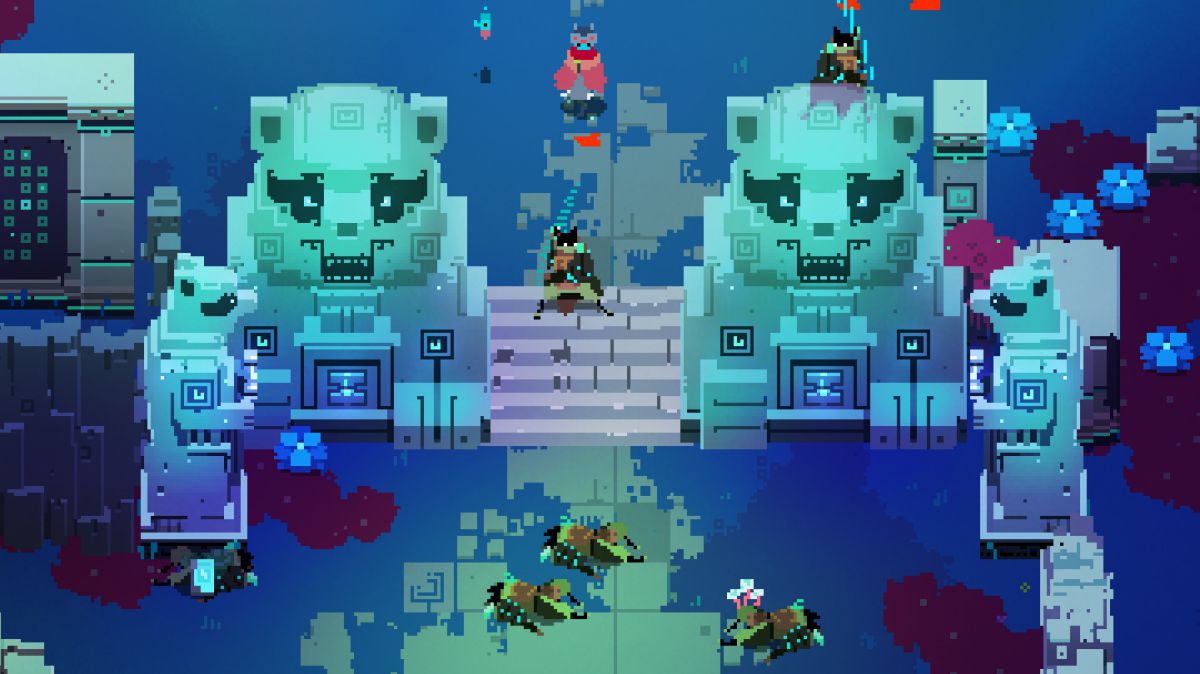
 Hyper Light Drifter has earned itself a rare distinction. It was a game that, despite my years of anticipation and incredibly high expectations, far surpassed anything I imagined. Hyper Light Drifter is amazing. I’m going to let past me have a turn at this again, “Hyper Light Drifter is a new classic. The game’s stunning art direction and soundtrack compliment an immensely satisfying gameplay experience. Combat is a perfect balance of simplicity with depth and fluidity with strategy. Hyper Light Drifter creates a world that is easy to get lost in and is filled with hidden secrets. The game does so much with so little and respects the player’s intelligence and perseverance throughout. Hyper Light Drifter should not be missed. It is easily one of 2016’s best.” Yeah, it sure is. You really should read my full review of Hyper Light Drifter here. There are so many reasons it is one of the year’s best games—too many to write here now. Just do yourself a favor and go play it.

2. Uncharted 4: A Theif’s End
Nobody does cinematic storytelling better than Naughty Dog, and they made one of their best in Uncharted 4. Uncharted 4 is the culmination of a long running, and critically acclaimed, franchise that bests all entries before it. We’re given a more nuanced take on adventuring, the price of ambition, and the lengths people will go to protect the people they love. Uncharted 4 refines and adds to the gameplay in ways that tighten up a franchise in little need of improvement. Uncharted 4 was so good it made me look more favorably on the entire franchise. It was always something I enjoyed, but never felt like a key part to my gaming identity. After Uncharted 4, Uncharted is integral to my gaming lineage. And that’s an accomplishment a precious few franchises can boast. For more about what I actually loved about the game itself, you can read my full review here.

1. Overwatch
 For the longest time (really, I mean long) Uncharted 4 was my 2016 game of the year. It gave me everything I could ever ask for in a game of the year. But then there was Overwatch. A game that, for most people, defined 2016. Rescued from the ashes of a failed MMO, Overwatch took everyone by surprise (myself included) with how brilliant it was. Overwatch is game design euphoria. As Blizzard always does, the gameplay is refined to a razor’s edge. Simple, elegant, but with extraordinary depth. Overwatch made me care for and identify with 20+ insane characters. It soothed during hard times and had me yelling at the TV in frustration at others. Overwatch stuck with me throughout 2016, grew as I grew, changed as I changed. I thought I was done with competitive FPS games. Overwatch proved me wrong. I thought hero shooters would all suck. Overwatch proved me wrong. I thought I wouldn’t adopt another lifestyle game. Overwatch, again, proved me wrong. Overwatch celebrated joy and diversity in a year desperately needing positivity. And it delivered on all its promises (some of which I detail in my review). I’m thrilled with the year I spent playing Overwatch, and I’m looking forward to keeping it a small part of my life as 2017 rolls on. Congratulations Overwatch! You are The Impact Factor’s 2016 Game of the Year!

Tuesday, July 26, 2016

A Musical Of Punches: Disjointed Narrative and Street Fighter V
Perspectives

Abstract: Street Fighter V’s long awaited story mode is terrible. The writing is poor and the plot is something you’ve already seen a thousand times. The narrative and gameplay poorly align, transforming the story mode into a bizarre musical where punches and shoryukens are the songs. Like many other games, Street Fighter V makes the mistake of relying too strongly on film as the model on how to shape its story. When video games lean into what makes them unique from movies, like their interactivity and perspective, their narratives can succeed.

Let’s not beat around the bush here, Street Fighter V’s story mode is bad. Almost unplayably so. It is a huge bummer. As a kid that grew up glued to the shiny Street Fighter II arcade cabinet, I spent hours creating the world of Street Fighter in my mind. From character dialogue to stages to moves, I used everything I could to create the universe. Given my past experience with Capcom fighting games my expectations for Street Fighter V’s story mode were quite low. It promised to be a step above the comic book freeze frame storytelling of Capcom’s games past games, with 3D models and dialogue and a compelling narrative. I suppose it delivers two of the three.

As of writing this, I’m a little past the story mode’s halfway point. What I’ve experienced so far is 90 minutes of stilted dialogue and haphazardly assembled vignettes that roughly come together to form a narrative. Street Fighter V’s story mode represents so much of what has been wrong with narrative in video games. The writing is god awful. The plot is something a middle-schooler could have whipped up on a lazy afternoon. The action is disjointed—characters hop around with little to no sense of geography or time, motivations shift dynamically and without purpose, and every scene is just an excuse to hobble together an eclectic group of characters to, you guessed it, fight each other. Street Fighter V’s final offense is one that’s been committed over and over again in video games: the gameplay and story are totally disconnected.

Guys, please. Street Fighter V's story isn't worth the fist bump.
Street Fighter V’s story mode is broken up into two discrete parts: non-interactive cutscenes and fights. Never do the two really meet. The narrative heft is put forward in the cutscenes. The Shadaloo bad guys explain why they want to EMP the world, the good guys talk with one another to plan how to stop the evil organization, etc. The fighting, however, exists almost totally outside of the story. In fact, most fights in the story feel forcefully injected between the plot that’s taking place. Characters will get mad at one another at the drop of a dime, or out of the blue will demand a test of a fighter’s skill. Anything to get two people to clash. Playing through the story mode is a strange experience. The shift between cutscene movie and fights is jarring. Many characters come across as trigger-happy psychopaths looking for any excuse to hadouken one another. Street Fighter V’s story mode never lets characters earn their right to fight one another, nor does it skillfully blend fighting in with the larger narrative.

I'm sure you can guess the outcome of the scene by now.
In many ways, playing Street Fighter V’s story mode is like watching a musical. The characters go about their business until BAM, they suddenly need to fight. Like a musical in which people suddenly need to sing. This isn’t the first time this particular dissonance between gameplay and story has been compared to theater. Scott Pilgrim vs. the World director Edgar Wright described how he approached blending the titular character’s fights into the film saying, “We thought it should play out like a musical in a way in terms of the fights are not dissimilar to the songs.” Scott Pilgrim leaned heavily on video games as an influence. This approach worked for Scott Pilgrim, perhaps given the strength of the writing and directing of the film. It doesn’t change the fact that the fights are jarring, dislodging the viewer (if only momentarily) from the experience. That jolt has a more profound impact when playing a video game like Street Fighter V. The player agency in the action combined with the general interactivity of video games make it so that, when gameplay is inelegantly inserted into game’s narrative, you’re thrown pretty far off from the experience.

Scott Pilgrim is a good musical of punches. Street Fighter V is not.
Street Fighter V also suffers from a problem very recently highlighted by the great Brad Bird. Bird shared his concerns about using video games as inspiration for filmmaking and storytelling in a recent interview. The director of The Iron Giant and The Incredibles cited video games’ point of view problem. He said, “I feel like video games are a bad influence for storytelling because they are not directed points of view. They are about floating around universes…a lot of times it’s just motion.” Story mode in Street Fighter V is all about universe and not about a singular, or cohesive, point of view. Perspective shifts happen every couple minutes. Huge fluctuations in characters and tones and locations happen so frequently it is easy to get lost in the fold. By giving every character equal representation in the plot, no one matters. The end result is schizophrenic and astonishingly boring. There’s nothing compelling you to get attached or to move forward.

As inflammatory as Bird’s statement can come off, he does hit on a truth that video game narrative creators need to realize. Simply adapting a film approach and applying it to video games rarely works. It is immediately obvious that Street Fighter V wants the story mode to feel like a movie. Fortunately we already know how well a Street Fighter movie works, and it’s not very pretty. Games have long thought going the Hollywood route is the way to bring great narratives into video games. Rarely is that the case. Only the true masters of the craft can get away with this approach, like Naughty Dog with The Last of Us and Uncharted 4. Nearly every other film-inspired story mode in video games comes across, at best, like a good “B” movie. It’s a point of view problem, it’s a length problem, and it’s an interactivity problem.

Unless you're Naughty Dog, your studio might want to think twice about
making your story "cinematic."
While Street Fighter V fundamentally misunderstands what makes a video game story great (hint: it’s not about making a musical of punches), other games shape narrative construction to fit the unique vehicle that is video games. In response to Brad Bird’s statement about video game narrative, creative lead at Naughty Dog Neil Druckman tweeted, “Someone needs to play Brothers [A Tale of Two Sons] or Ico or Papers Please or Portal or Inside or The Secret of Monkey Island or…” Druckman is right and Bird is wrong. There are fantastic narrative in games. Druckman’s list has something in common, though—none of these games structure their story like a movie. Video game narratives work when they lean into the interactivity inherent in games, and from the unique perspectives games can offer the player. Certain narrative devices like environmental storytelling work so well in games, even outshining their film peers. Games like Gone Home and Portal and Ico and Firewatch have fantastic narratives that would never work the same way on film. Video game narratives have the potential for greatness when they are designed from the ground up to be a video game narrative, not a movie facsimile.

The best video game stories adapt narrative structures to fit
the interactive medium they exist within.
For my love of Street Fighter and its characters I’ll fight my way to the end of Street Fighter V’s story mode. I owe it to my arcade heritage and my fondness for the fighting game community. I just wish Street Fighter V was more Shadow of the Colossus and less “action-movie the fighting game musical."

Friday, June 3, 2016

News & Views
5/28/16-6/3/16

This week went by in an instant. I had a great time relaxing with my fiancée, got some nice experiments done in lab, and of course I played the hell out of Overwatch. It has been years since I got this sucked into a multiplayer shooter.

News & Views collects the week’s best video game writing. Check out the links below for stories about how Rocket League strategies have made it clear that the game is more than just soccer with cars, how Final Fantasy IX handles the inevitability of death, and why crafting that perfect ending to your game might not be worth it.

And of course please check out the brand new episode of The Impact Factor podcast that was posted today! You can subscribe to the podcast on iTunes, or if you prefer other methods, check out our SoundCloud. We’re on YouTube too!

Spotlight
Gino Grieco, Giant Bomb

Worth Reading
Bhernardo Viana, Kill Screen

Jake Parmley, Gamasutra

Nico Deyo, Paste

John Macone, Eventhubs

Greg Kasavin, PC Gamer

With Comments
Angus Morrison, PC Gamer
Blizzard came out early and aggressively against Overwatch cheaters. In fact, they promised to permanently ban a player after their first offense. Little did we know how serious Blizzard was. I’ve copied an anecdote from the article that summarizes it perfectly: You cheat, you lose. Period.

"Got banned one day after the official release," one enemy of fair play recounts. "Thought I got detected for using RPM tools, because the game was crashing for it at that time.
"Bought the game again... didn't hack on it at all, just wanted to enjoy the game a bit. Two days later—banned again.
"Bought the game... again. But before doing that, I deleted Overwatch and launcher completely. Enjoyed it again without cheating only for a day."
            On his fourth attempt, he purged his PC, changing hard drive IDs, MAC address, BiosDate and buying a VPN to throw Blizzard's anticheat off. It didn't work.

Evan Narcisse, Kotaku
When the term “ludonarrative dissonance” was common parlance in the greater games discussion, Uncharted was always the first title named. People weren’t wrong for naming it, either. How can Nathan Drake be a loveable rogue when he literally kills hundreds of people each and every game? Part of what I touched upon in my review, but it written much better by Evan Narcisse over at Kotaku, is how Uncharted 4 leans into this dissonance – co-opting it to serve as the narrative foundation. Beware spoilers, but thoroughly worth reading.

Matt Sayer, Unwinnable
It astounds me how few game owners finish the games they buy. Since the advent of trophies / achievements, it has been possible to ascertain completion percentage on a game-to-game basis. As Matt Sayer writes, laughably few players manage to finish games. Even when a game is just a few hours long the completion percentage remains sub 50%. It’s insane. Maybe it’s not so important to have that perfect ending to your narrative game. Chances are no more than 30% of players will even get to it.

Tuesday, May 24, 2016

Greatness From Small Beginnings
Review
Uncharted 4: A Thief’s End, Naughty Dog (PS4)

Abstract: Uncharted 4: A Thief’s End is a fantastic send off to one of PlayStation’s marquee franchises. Naughty Dog is peerless at crafting cinematic narrative adventures and their skill shines through in Uncharted 4. The game tells a more nuanced narrative than previous entries, filled with great character moments, dialogue, and themes that resonate throughout your experience. Uncharted 4 features smart improvements to nearly all gameplay systems, from more rewarding combat to more thrilling platforming. Uncharted 4 will no doubt be a highlight of 2016 and is easily one of my favorite games this year.

Sic parvis magna. “Greatness from small beginnings.” These are the words that accompanied the intrepid Nathan Drake throughout his five game journey. The words ring true for the franchise as a whole. Naughty Dog had accrued trust with their earlier titles, Crash Bandicoot and Jak and Daxter, but hadn’t really made it into the hall of the ‘greats’. Their first outing on the PS3, Uncharted: Drake’s Fortune, looked to propel the studio to new heights. The jaw-dropping Uncharted 2 all but solidified their claim. Nearly a decade after the series began, Uncharted 4: A Thief’s End marks the conclusion to the widely-acclaimed series. And what an ending it was.

I apologize in advance for a bit of hyperbole here, but Uncharted 4 is the best action movie I’ve ever played. Uncharted 4 builds upon the series’s past successes meaningfully, draws inspiration from its contemporaries, and delivers a nuanced adventure that is not only satisfying in its own right but confidently concludes Nathan Drake’s adventures.

Uncharted 4 takes place several years after the conclusion of the previous game. We find Nathan Drake living a quiet life, working salvage and stamping papers behind a desk. The game’s story revolves around Sam Drake, Nathan’s older brother (whom we had never heard of before). You quickly discover that Sam is not as dead as Nathan thought, and that he is in desperate need of Nathan’s help. Sam needs to finish an adventure the two started over 15 years ago – finding the legendary pirate Henry Avery’s long lost treasure. We follow their quest around the world, following hidden clues, solving deadly puzzles, fighting against an entire militia who wants the treasure for themselves, and for the first time, introspection. Uncharted 4’s narrative is more than just setpieces and globetrotting; it’s about Nathan Drake and the life he has led up to this point. Uncharted 4 is not a standalone adventure. Moreso than any Uncharted game before it, Uncharted 4 is a direct sequel to the narrative threads laid out by its predecessors. It’s for this fact that I want to clarify right now that you should not play Uncharted 4 before playing the previous Uncharted games. You will miss out on too much, from call backs to character moments.

Welcome to the end of a great adventure.
In reading other reviews, I’ve seen the word “mature” being tossed around to describe Uncharted 4’s story. Maturity is a complex and abstract concept, so I want to avoid using it here. Uncharted 4’s plot, however, is more nuanced than previous entries. It has a depth, mostly via a real exploration of its character’s motivations and personalities, that made what happens feel more substantive. As much as I loved Nathan from previous adventures, he was a pretty one note character – a quippy ubermensch. He was the fun-having, joke-cracking, bad guy-killing treasure hunter we all know from pulp fiction. In Uncharted 4, though, we’re given a more nuanced view of Drake. Why is he the way he has been in previous games? What motivates his treasure hunting? What makes him uncomfortable with normal life? Is Nathan Drake a good person? This exploration of character extends to many of the game’s supporting cast, from Sam to Elena to Sullivan. Character development is bolstered by Uncharted 4’s decision to pair Nathan up with a partner throughout the game. Similar to what we saw in The Last of Us, this partnering allowed for fantastic back and forths between characters (made even better by the game’s great writing). Perhaps the biggest compliment I can give the story is this: it never felt secondary to the action or setpieces. Uncharted 3 in particular felt like it wanted cool moments above all, and made a story to support their inclusion. In Uncharted 4, everything is about the end of Nathan’s adventure and his relationships to the people who know him best. Uncharted 4 wraps up Nathan Drake’s adventures in a deeply satisfying way.
 
There are action setpieces to be found, of course, but Uncharted 4
 always puts the characters and narrative first.
I appreciated the layers present in Uncharted 4’s narrative, too. The game is more than just one last adventure for a famous treasure hunter and his long lost brother. Uncharted 4 comments on the very nature of chasing impossible dreams. Nathan Drake’s last adventure is scaffolded with characters, and collectibles, that serve as an allegory for his arc. Essentially every character in the game, alive or dead, is a reflection of one of Nathan’s qualities. The overarching theme to the game is the cost of ambition. Naughty Dog does a phenomenal job at reinforcing this theme throughout, while avoiding clichés. For example, Uncharted 4 has phenomenal environmental storytelling. The world, and the collectibles within, offer side narratives and characters that meaningfully add to the story taking place at the game’s surface. Repeat playthroughs would no doubt further elucidate Uncharted 4’s dense narrative world, which makes me respect it all the more.
 
Where is the line between greed and ambition? What is
worth losing in pursuit of treasure?
Uncharted 4 is not just narrative, however. There is a whole lot to like about the gameplay. Uncharted 4 is a wonderful optimization of the franchise’s gameplay. Combat saw across the board improvements. For the first time, shooting felt asterisk-free “good.” Guns sound and look and aim like you would expect them to. Each weapon has an identity, which was great, as low ammo meant you constantly have to use whatever you can find. Enemy encounters feel handcrafted in the best possible way, giving players a dynamic environment that favors mobility and shifting tactics over hiding behind one piece of cover for the entire fight. Stealth has been improved, making it viable to silently take out the majority of your foes. Uncharted 4 added several quality of life features to combat as well. For players who want to engage with the story, but aren’t great at aiming, the game offers an auto-lock on feature that can be toggled on or off at any time. All enemies can be marked, giving players the tools to better plan their attack. On top of all that, Uncharted 4’s enemies are the least bullet sponge-y than they have ever been. Even on the hardest difficulty enemies go down with a few well-placed shots. This not only reinforces player skill but keeps the game’s momentum moving forward at all times.

Platforming, another essential part of Uncharted, has seen similar across the board improvements. The animations in this game are incredible, reinforcing the physicality of both the world and characters as you jump and climb your way around. Navigating through the environments has been made decidedly less constrained. Uncharted 4 offers several paths for players to take to get from A to B, from its more open environments down to even the handholds or ledges themselves. It removes the feeling of being shuttled down a corridor, enhancing immersion. Uncharted 4 introduces a series first handful of truly open environments. You have a set objective, but are free to wander and explore beautifully detailed and wide-open spaces. These are hit and miss, unfortunately. I enjoyed the sense of discovery and the great dialogue that happened while exploring, but overall the environments felt a bit too large (& too empty) to be worth scouring. A minor gripe to be sure, as you don’t spend long in any of these settings, but one that could have been tweaked to improve the player experience.
 
Encounters encourage mobility and experimentation.
No more being trapped behind chest high cover!
Puzzles make their return, of course, and are better than ever. For a game that so heavily relies on narrative momentum, puzzles can be a risky proposition. You don’t want the player to torture themselves trying to figure out something overly complex. Nor do you want them to be so easy they might as well have not been there. Uncharted 4 straddles this boundary perfectly. Some puzzles are more successful than others, but for the most part, all are just hard enough and just quick enough that I felt both satisfied to have solved it and happy to move forward. One puzzle in particular, found at the end of the game (symbols on floor squares), is now a franchise favorite of mine. Serious Indiana Jones vibes in all the right ways.
 
You won't be scratching your head too long trying to solve Uncharted 4's
puzzles. Which is great!
The biggest change to the Uncharted gameplay formula, rather than just refinements, is the addition of the rope. Nathan and his brother come equipped with a grappling hook-tipped rope that they use liberally throughout their adventure. The rope’s inclusion is odd at first, since Nathan was never previously the Tarzan type, but it eventually clicked and added a nice new layer to playing. Hilariously, its inclusion is even explained through the narrative. Swinging from cliff edge to cliff edge adds tension to platforming. Swinging around in the open air creates some beautiful vistas. Last minute hooking onto distant structures is built into some of the game’s best setpieces. The rope also adds to the dynamism of combat. Several of the game’s combat encounters have rope points, allowing you to swing action movie style from building to building, firing upon foes from midair. All it took was one dramatic midair headshot from my AK-47 to melt away all my rope skepticism. It’s a great addition.

It's hard not to grow attached to the rope. Moment-to-moment or action setpiece,
the rope is consistently fun.
As I mentioned on our podcast, Naughty Dog is peerless in the industry. No one can deliver gripping cinematic narrative adventures like they can. One of the ways in which they solidify their number one spot is just how fantastically detail oriented the team is there. Tender love and care bleed through every corner of Uncharted 4. For starters, Uncharted 4 is probably the most graphically stunning game I’ve ever seen. Character models, facial expressions, physics, environments: Uncharted 4 is jaw-droppingly gorgeous. I honestly do not even know how they do it. Uncharted 4 looks better than other games running at max specs on several thousand dollar PCs. It’s crazy.  The TLC goes much further than looks, though. Everything in the game is scripted well, reacts naturally, and feels real. The game has a ton of extra features and accommodations to players of all skill levels, interest levels, and engagement. Upon beating the game you unlock a wealth of content, including game modifiers (like spawning guns or bullet time mode) to aesthetic features (like a full 8-bit mode) to unlocking specific encounters for players to replay. The game’s epilogue in particular showcases how much Naughty Dog cares about its characters, its world, and its fans. Uncharted 4 is a rich game.

My eyes welled up with tears when I set the controller down at the end of my adventure. Uncharted is always a series I liked, but after A Thief’s End, it’s now a series I love. Nathan Drake is definitively done adventuring, so I guess I have to be too. It was great seeing him through his fantastic adventure, and I’m thrilled that Uncharted got a perfect send off with Uncharted 4: A Thief’s End. I’ll miss you, buddy.

Uncharted 4: A Thief’s End
5/5

Friday, May 20, 2016

News & Views
5/14/16-5/20/16

This week has been pretty incredible. I still can’t believe I got to play, and finish, Uncharted 4. What a game. Expect a review here next Tuesday. And there’s so much more! Survivor’s finale, warm weather, and the promise of summer fun has me feeling great. Now onto the real meat of the post.

News & Views collects the week’s best gaming editorials, opinions, and more into one convenient place. This week I found stories about the woman who invented cosplay, the grief of finishing a great video game (I’m feeling it with Uncharted 4), and the ever changing role of a game’s publisher in major eSports scenes. You should give them all a look and let me know which ones resonated with you!

And of course please check out the brand new episode of The Impact Factor podcast that was posted today! You can subscribe to the podcast on iTunes, or if you prefer other methods, check out our SoundCloud. We’re on YouTube too!

Spotlight
Keith Stuart, The Guardian

Worth Reading
Andrew Reiner, GameInformer

Sam Greszes, Kill Screen

Jennifer Culp, Racked

Patrick Miller, Giantbomb

Bryce Blum, ESPN

With Comments
Anthony Burch, Destructoid
Burch spotlights a problem not a lot of us think about – leveling systems. Visualizations of progression can be an extremely powerful hook in gaming, so much so that they can often impact how you play a game. Leveling in multiplayer modes specifically can create this terrible mind space, where you only are playing to level up. In certain games (RPGs) I quite enjoy leveling systems, but not every game needs gear you can strengthen, or player levels to increase. Great thoughts.

Nathan Ingraham, Engadget
Shortly after watching the high-octane trailer for Battlefield 1, I started to ponder the implications of what a World War I shooter would actually be. WWI was a terrible, brutal, bloody, inglorious and awful war. Battlefield is known for cartoonifying war so it felt odd that their team would try to depict WWI. I certainly “have the stomach” for Battlefield 1, but there is a lot to think about here.

Katherine Cross, Gamasutra
It might seem strange for me to spotlight Cross’s article here since The Impact Factor uses review scores, but I totally agree with the points she makes. Review scores, overall, are useless. Not only do they often say nothing, more often than not they stifle the conversation surrounding games (oh, it’s only a 7.5? Not worth my time). Scores can be helpful in establishing a certain kind of quality to a game, but they should not be the be all end all. I also went with a 5 star system here as to not play into the other terrible aspect of review scores – their inclusion in score aggregate sites. There is a lot to chew on here.

John Walker, RockPaperShotgun
John Walker’s article about whether or not you need to be good at games stimulated a lot of discussions online. On one hand, I agree with his title. You do not have to be good at games to enjoy them. But then again, I do think a certain level of competency is essential in reviewing games. Walker conflates this “GIT GUD” mentality for reviewers versus fans, but overall I quite liked the piece. People should never use skill at gaming to make someone feel like they don’t deserve to be playing. 
The Impact Factor Ep. 55: Uncharted Game Dev Territory
Podcast
Welcome to the 55th episode of The Impact Factor! The Impact Factor is what happens when two scientists, and two best friends, get together to talk about video games. Hosts Alex Samocha [biomedical scientist] and Charles Fliss [social scientist] sit down every week to discuss the week in gaming! Listen in for the news, views, and games that made the biggest impact!

Please send your suggestions and feedback to: impactfactorpodcast@gmail.com

In this episode Alex and Fliss talk about Disney Interactive, Twitch chat, eSports, WESA, Star Wars Battlefront 2, Civilization 6, Overwatch, game dev, Clash Royale, Uncharted 4 and much more!

CoolGamesInc. podcast


YouTube page

For articles and reviews from Alex, check out: www.theimpactfactor.blogspot.com
For a blog about Japan, pop culture & more from Fliss, check out:
www.flissofthenorthstar.blogspot.com

Follow Alex @alexsamocha on Twitter. twitch.tv/megalodonphd
Follow Fliss 
@thecfliss on Twitter. twitch.tv/flissofthenorthstar

Intro song:
You Kill My Brother by Go! Go! Go! Micro Invasion, East Jakarta Chiptunes Compilations. Freemusic Archive. (Attribution Noncommercial Share-Alike License)
Transitions:
News & Views and Perspectives transitions from victorcenusa, Freesound.org (Creative Commons 0 License)
Experimental Methods transition from Sentuniman, Freesound.org (Attribution Noncommercial License)