Showing posts with label Hyper Light Drifter. Show all posts

Friday, January 6, 2017

The Impact Factor’s Top 10 Games of 2016!
Perspectives


2016. It’s a year that’s best described by the number itself. No year has been as explicitly independent from other years in recent memory as 2016. The year was a rollercoaster for most, one many of us were more than happy to hop off by the end of December. In my life, 2016 is a year of extraordinarily high highs, and some pretty low lows. I will forever cherish 2016 as the year I got married to the love of my life, Justine. We grew together and shared so much in 2016 it’s hard to look back on the year as a whole negatively.

2016, however, was also a year that showed us that hate and ignorance is alive and well—and that, politically at least, it will only continue to grow in the months and years ahead. 2016 was also the year I realized I had to take a step back from The Impact Factor. Graduate school demands materialized as shackles, and there were several times throughout the year I felt utterly defeated by my Ph.D. work.

But thankfully you’re all here for the games. I am too. 2016 has been a surprisingly stellar year, from AAA to indie. Though still not all the way there, this current console generation seems to finally have its feet under it. 2016 was the year of virtual reality, games that celebrated diversity, and pure gameplay joys that need little explanation. Cutting my favorite games of the year to just ten titles was challenging. Ordering those ten was an even bigger hurdle. But I did it!

My list this year is best in audio form, which you can find by checking out Episode 88 of The Impact Factor podcast.


If you don’t have the time, or you don’t enjoy the sound of my voice, don’t worry. You can check out my top ten games of 2016 right here!

10. Final Fantasy XV

A late contender to the list but one that well-earned its spot here, Final Fantasy XV delivered something I thought impossible: a great new Final Fantasy game. FFXV had the odds stacked against it. Not many games can come out the other side of a tortured decade-long development playing as well, looking as great, and being as engaging as FFXV is. The game is not without its problems. Tedium is built a little too intractably from its open world and the second half has some serious pacing & design problems. But every single time I picked up FFXV I didn’t want to put it down. Combat is fantastic. The characters are endearing, distinct, and show an underrepresented side to male companionship. FFXV had me hooked from start to 50+ hour finish, and is easily in my top five of the franchise.

9. Overcooked
Frantic fun is the name of the game (it’s Overcooked, actually) in this couch co-op gem about working as a chef. Yeah, you read that right. A cooking game is in my top ten games of the year. And honestly, it could easily be so much higher. Overcooked is uproariously fun. The intricate choreography of prepping ingredients, cooking food, plating and service is satisfyingly skill intensive. Achieving a 3-star rating on every level is a challenge, and one that my wife and I had the pleasure of accomplishing. Overcooked combines its simple but perfect gameplay with a charming aesthetic, a memorable soundtrack, and an awesome throwback world map. Overcooked is couch co-op at its finest and one of the year’s biggest surprises.

8. Clash Royale
When a new mobile game usurps my Hearthstone time for the better part of a year, I need to give it serious game of the year thought. And thought I did. For the longest time, Clash Royale existed just outside of my top ten. It was fun, sure, but it also has serious faults that even after 9+ months of playing I cannot get over.  But that ignores the fact that I have been really enjoying Clash Royale for 9+ months. I play the game daily. Still. Clash Royale’s hybrid of competitive card game with tower defense and real time strategy still boggles my mind. The mix works so well. Whether duking it out in legendary arena, playing in special event challenges, or trying out new decks, Clash Royale has provided a consistently fun experience that’s defined my 2016 gaming. It deserves its spot here. If you’re curious, you can read my review for the game here. The only thing that has changed since then is that I like it even more. It would still get 4 stars, though.

7. Dark Souls III
The alleged end of the storied franchise, Dark Souls III delivered on all fronts. The game maintains the brilliant design, excellent balance of risk and reward, and eerie fantasy setting that’s a staple for the franchise. Like the other Souls games before it, once I started playing Dark Souls III, I couldn’t stop until I had defeated every single boss and scoured its immense world. Dark Souls III righted the slight wrongs of its predecessor, returning the series to peak form. Playing the game truly felt like the end, with plot callbacks throughout. Dark Souls III was the first Souls game, however, in which I started to feel slight franchise fatigue. It makes me extra happy then that the series gets to end on a high note, long before I crossed too far into exhaustion. Dark Souls III is fantastic. For more detailed thoughts about the game, please check out my review here.

6. Inside
 Here’s an almost impossible argument to make: “so-and-so is a perfect game.” What game would be in consideration? What even is a perfect game? After weeks of reflection, Inside comes pretty darn close. Every single element of Inside hits the nail squarely on the head. Creepy, dystopian aesthetic? Perfect. Platforming physics and challenges? Perfect. Puzzles? Perfect – they never keep you stalled for long but are just hard enough to give a satisfying sense of completion once solved. Surprises? A meta-narrative about playing games? Check and check. Inside is a game you could tell took full advantage of its six year development cycle. Inside learns from its predecessor, Limbo, and improves every single aspect. I got lost in Inside’s world and challenges. The only thing going against Inside is that I haven’t really thought about it much after completion. Still, Inside is a tremendous achievement and I game I think everyone should play. Everyone.

5. Firewatch
 I’m going to let my review do most of the talking here, “Firewatch is a game, a vignette of the human experience, that’s in a league of its own. There are no aliens, no headshots, no fate of the world, not even a focus on one of life’s particular moments.Firewatch transports the player into a snapshot of existence. It takes you to a time and a place and a mindset we haven’t really seen before in games. Firewatch is gorgeous, well-written, well-acted and gripping. The game skillfully touches on themes of love, loss, isolation and paranoia, delivering a mature narrative that has stayed with me. I give it my highest recommendation.” Well said, early 2016 me. Nearly a year later Firewatch still means a lot of me. It was an engrossing, human experience that gave me something I never knew I wanted in games.

4. Enter the Gungeon
 I love roguelikes. It should come as no surprise that much like in 2015 when Nuclear Throne slipped into my top five, so too would another absolutely phenomenal roguelike. This year, it’s Enter the Gungeon. Enter the Gungeon does so much so well I don’t really even know where to start. The game mashes together the fast, bullet-hell + twin-stick gameplay of other roguelikes with depth and mystery matching the best in the roguelike genre. Enter the Gungeon’s gameplay loop is endlessly addictive. I played off and on for months, ignoring big releases to focus on perfecting my runs. The freshness new guns, items, and characters add to each run meant that the dozens of hours I played never felt boring. Enter the Gungeon has a brutal skill ceiling that always pushed me to try harder and do better, with challenges I have yet to beat still calling out to me. Enter the Gungeon has etched its name into my pantheon of extraordinary roguelikes, and I’m excited to jump back in. For more detailed thoughts on the game, you can find my full review here.

3. Hyper Light Drifter
 Hyper Light Drifter has earned itself a rare distinction. It was a game that, despite my years of anticipation and incredibly high expectations, far surpassed anything I imagined. Hyper Light Drifter is amazing. I’m going to let past me have a turn at this again, “Hyper Light Drifter is a new classic. The game’s stunning art direction and soundtrack compliment an immensely satisfying gameplay experience. Combat is a perfect balance of simplicity with depth and fluidity with strategy. Hyper Light Drifter creates a world that is easy to get lost in and is filled with hidden secrets. The game does so much with so little and respects the player’s intelligence and perseverance throughout. Hyper Light Drifter should not be missed. It is easily one of 2016’s best.” Yeah, it sure is. You really should read my full review of Hyper Light Drifter here. There are so many reasons it is one of the year’s best games—too many to write here now. Just do yourself a favor and go play it.

2. Uncharted 4: A Theif’s End
Nobody does cinematic storytelling better than Naughty Dog, and they made one of their best in Uncharted 4. Uncharted 4 is the culmination of a long running, and critically acclaimed, franchise that bests all entries before it. We’re given a more nuanced take on adventuring, the price of ambition, and the lengths people will go to protect the people they love. Uncharted 4 refines and adds to the gameplay in ways that tighten up a franchise in little need of improvement. Uncharted 4 was so good it made me look more favorably on the entire franchise. It was always something I enjoyed, but never felt like a key part to my gaming identity. After Uncharted 4, Uncharted is integral to my gaming lineage. And that’s an accomplishment a precious few franchises can boast. For more about what I actually loved about the game itself, you can read my full review here.

1. Overwatch
 For the longest time (really, I mean long) Uncharted 4 was my 2016 game of the year. It gave me everything I could ever ask for in a game of the year. But then there was Overwatch. A game that, for most people, defined 2016. Rescued from the ashes of a failed MMO, Overwatch took everyone by surprise (myself included) with how brilliant it was. Overwatch is game design euphoria. As Blizzard always does, the gameplay is refined to a razor’s edge. Simple, elegant, but with extraordinary depth. Overwatch made me care for and identify with 20+ insane characters. It soothed during hard times and had me yelling at the TV in frustration at others. Overwatch stuck with me throughout 2016, grew as I grew, changed as I changed. I thought I was done with competitive FPS games. Overwatch proved me wrong. I thought hero shooters would all suck. Overwatch proved me wrong. I thought I wouldn’t adopt another lifestyle game. Overwatch, again, proved me wrong. Overwatch celebrated joy and diversity in a year desperately needing positivity. And it delivered on all its promises (some of which I detail in my review). I’m thrilled with the year I spent playing Overwatch, and I’m looking forward to keeping it a small part of my life as 2017 rolls on. Congratulations Overwatch! You are The Impact Factor’s 2016 Game of the Year!

Friday, September 16, 2016

The Impact Factor Ep. 72: Pumpkin Spice Enema
Podcast
Welcome to the 72nd episode of The Impact Factor! The Impact Factor is what happens when two scientists, and two best friends, get together to talk about video games. Hosts Alex Samocha [biomedical scientist] and Charles Fliss [social scientist] sit down every week to discuss the week in gaming! Listen in for the news, views, and games that made the biggest impact!

Please send your suggestions and feedback to: impactfactorpodcast@gmail.com

In this episode Alex and Fliss talk about Tokyo Game Show, Death Stranding, Gundam Vs., Kingdom Hearts, Danganronpa 3, PS4’s terrible news week, The Last Guardian, NoClip, Hearthstone, Hyper Light Drifter, and the Top 5 games we’re ashamed we haven’t played yet!


YouTube page

For articles and reviews from Alex, check out: www.theimpactfactor.blogspot.com

Follow Alex @alexsamocha on Twitter. twitch.tv/megalodonphd
Follow Fliss 
@thecfliss on Twitter.

Intro song:
You Kill My Brother by Go! Go! Go! Micro Invasion, East Jakarta Chiptunes Compilations. Freemusic Archive. (Attribution Noncommercial Share-Alike License)
Transitions:
News & Views and Perspectives transitions from victorcenusa, Freesound.org (Creative Commons 0 License)
Experimental Methods transition from Sentuniman, Freesound.org (Attribution Noncommercial License)

Tuesday, September 13, 2016

Beautiful Spectrum
Review
Hyper Light Drifter, Heart Machine (PS4)

Abstract: Hyper Light Drifter is a new classic. The game’s stunning art direction and soundtrack compliment an immensely satisfying gameplay experience. Combat is a perfect balance of simplicity with depth and fluidity with strategy. Hyper Light Drifter creates a world that is easy to get lost in and is filled with hidden secrets. The game does so much with so little and respects the player’s intelligence and perseverance throughout. Hyper Light Drifter should not be missed. It is easily one of 2016’s best.

Hyper Light Drifter makes me jealous. Not as a game designer, not as a critic, but as a scientist. In many ways, Hyper Light Drifter resembles the perfect kind of research manuscript. The game sets itself a goal and accomplishes it with resounding success. And, with what feels little effort. More than that, though, Hyper Light Drifter does so much with so little – it is the perfect combination of small parts that delivers an extraordinary experience. Hyper Light Drifter is simple, but underneath that simplicity (as any good research scientist knows) there almost certainly was an excruciating struggle and peerless work. Hyper Light Drifter is everything I want my own thesis project to be: intrigue, complexity refined into perfect simplicity, and something that immediately grips its audience and doesn’t let go.

A fluorescent-steeped and moody prologue begins your adventure into Hyper Light Drifter. The textless exposition sets the stage of a world destroyed by giant monsters, a deadly disease, a sealed off power, and a people forced to rebuild. The quasi-medieval setting quickly unfolds into something much deeper, with echoes of a lost technological age. Your protagonist is a silent wanderer, donning a flowing cape, glowing sword, and small pistol. He finds himself in a small town with adventure waiting on all sides. The drifter seeks to explore the ruined world and uncover its truths. Along your journey you’ll fight monsters of all shapes and sizes, tyrannical bosses and treacherous terrain. Hyper Light Drifter’s narrative leaves a lot up to the player for interpretation, but by so confidently establishing both mood and lore I was immediately sucked in.

The world calls to me.
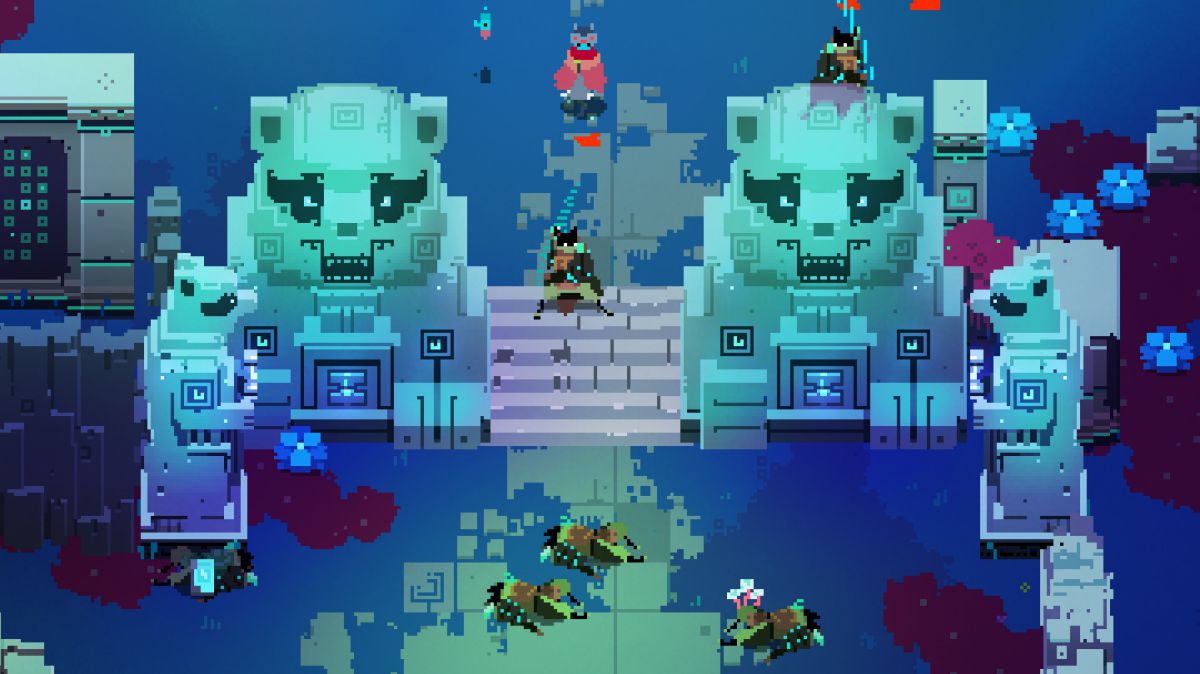
The game’s zoomed out isometric perspective gives a great view of its gorgeous world. Usually I wait until later in the review, but I can’t help myself. Hyper Light Drifter is an astoundingly beautiful game. From its animations to its highly detailed pixel art, the game’s aesthetic shines through. Snowy mountains, verdant forests, barren deserts are all wonderfully realized through Hyper Light Drifter’s unique perspective. The world has a certain indefinable charm that exists as a combination of art, music (by the amazing Disasterpiece) and enemy design. In all honesty, the art is what drew me from the start – as early as the game’s embryonic (i.e. Kickstarter) stages. I was so relieved to see the full realization of the designers’ vision in the game’s final release.

Hyper Light Drifter is a 2D action RPG. Gameplay divides nicely into a couple key areas: combat, upgrading your character, and exploration. Hyper Light Drifter’s combat is superb. Fights occur naturally when exploring, in set combat arenas, and against bosses. The drifter has a number of tools to deal with the monsters that flood the world. Your primary weapon is the sword. Enemies can be hit with quick single blows or, if you’ve read their patterns correctly, can be punished with a three-hit combo. Firing your sidearm can damage enemies at a distance. The damage is minimal, unless charged up for a big shot, and ammunition is limited (it refills slowly upon attacking foes with your sword). Your opposition is aggressive, so Hyper Light Drifter also provides the player fantastic tools for escape. You have access to a lightning fast dash move, which can be used offensively or defensively depending on your situation. The player is invulnerable for a short time while dashing, increasing the skill threshold as whole attacks can be mitigated by a well-timed dodge.

Nothing should be underestimated. Hyper Light Drifter
keeps you on your toes.
Combat starts slow as you learn the language of the game. Fluency comes rapidly, though, as your fights become a flashy choreography of dashes and sword strikes and weapon swaps. Mastery feels always just out of reach, perfect for a skill intensive game like Hyper Light Drifter. There’s always more to learn. Your skills are put to the test in boss fights. Bosses run the gamut of shapes and sizes but they always force fluency in some aspect of combat, whether it be pattern recognition, short punishes, or chain dashes. Hyper Light Drifter’s combat also quickly opens up to player customization. You’ll unlock new guns to bolster long distance or close range engagements and new abilities that make battles even more fluid. Combat is a perfect combination of simplicity and depth, risk and reward, and I couldn’t get enough of it.
 
Time to show what you've learned.
Speaking of unlocks, Hyper Light Drifter lives up to its RPG name by featuring a nice suite of methods to power up your hero. Gearbits can be found throughout the world and used as currency to unlock new abilities. Your sword can gain a charge strike to deal massive damage, or a dash strike to attack after a dash. Your dash can gain the ability to chain into itself infinitely and the ability to reflect enemy projectiles. While there are no stats to manage, Hyper Light Drifter does allow for the hero himself to be powered up. You can unlock the ability to carry more health packs, which is essential, as health never regenerates. As you progress through the game, you’ll also come across new outfits for the drifter. These are often more than just an aesthetic change as they can grant bonus abilities like faster ammo recovery or an extra point of health. Hyper Light Drifter is a great RPG while making your RPG-experience as streamlined as possible.

Streamlined or not, I enjoyed Hyper Light Drifter's RPG elements.
Exploration is where Hyper Light Drifter truly shines. Hyper Light Drifter has a world you want to get lost in. Tranquility belies a setting rife with intrigue. Tucked into every nook and cranny of the world is something interesting to see or some new item for your playthrough. The nonverbal communication of the game to the player is fantastic. You’re never told where to go or what path to take—everything is discovered through playing. You’re never told to look for secrets, nor are you told what to do with those secrets. There is a system in place that indicates where a secret hides, but Hyper Light Drifter relies on a player’s intelligence and perseverance to find the pattern. I hate comparing one game I’m reviewing to another, but I can think of no better way to put it here: playing Hyper Light Drifter evokes the same feeling I got playing the original The Legend of Zelda on the NES. The game is a puzzle box that can be solved as rudimentarily, or as meticulously, as you desire. The joy I felt moving from screen to screen scouring for paths is unparalleled in modern gaming. Exploring Hyper Light Drifter is part epic poem and part learning a new language, and the two combine to create something spectacular. There are a precious few games I wish I could erase from my memory so I could experience them again for the first time – Hyper Light Drifter is one of them.

In the spirit of the mostly wordless Hyper Light Drifter I attempted to keep this review brief. I could go on for another thousand words about the satisfying gameplay loop, the hidden bonus challenges, or how the real world around me dissolved while playing. Hyper Light Drifter is one of the most supremely well-designed games I’ve played all year. Hyper Light Drifter not only lived up to expectations, it created a new classic. Hyper Light Drifter is a wide spectrum of excellence not to be missed.


Hyper Light Drifter
5/5

Tuesday, August 30, 2016

Delightful Dashes: Moving Fast Never Felt Better
Perspectives


Video games are about motion. Across genres, across aesthetics, and across gameplay not many things are shared. Movement is something that’s been at the core of video games since their onset. Video games are about manipulating motion and using it to your advantage.

Just take a look back at some early games. Pong is ostensibly only about motion, as two players manipulate the way a square bounces back and forth across a screen. Galaga and Space Invaders were all about anticipating enemy movement while understanding your own. Tetris is a beautiful series of precise motions, a balance between time management and finesse. Motion is the vehicle by which games bring interactivity to the player.

Each genre engineers motion to suit gameplay demands. For some, it’s simple ups and downs along a straight path. Others it is 360-degree rotation on a 2D plane. As games moved into 3D movement evolved. Motion now wasn’t constrained by up-down-left-right, it could span the gamut of x-y-z axis coordinates. In building towards the level of sophistication required to master 3D movement, a concomitant rethinking of 2D motion occurred. Game developers sought to reimagine what movement along a 2D plane could mean for the player. New titles didn’t just focus on new worlds or narratives; they also focused on revolutionizing the way games handled.

From an early age I have been drawn to action games. I’ve enjoyed a variety of them for a variety of reasons, but one thing that has stayed consistent is how much I enjoy their movement. Quick, skillful combat requires mobility to match. For older action games like Ninja Gaiden or Castlevania, your options were often limited to jumps and good character placement. Over time a wealth of new options were added: like sprinting, blocking, dodging and warping. The mechanic that’s stuck with me the most, however, is dashing.

Dashes are a great solution to a common action game problem—how do you keep motion fluid during (and outside of) combat? A dash can get you from one place to another in a fraction of the time it would take to walk. A dash can also act as a split second, and skill intensive, system to avoid enemy attacks. There is something fundamentally game-y about dashes, too, which endears them to me. Like the double jump before them, dashes are something that comfortably exist outside of reality. Sure, someone could sprint a short distance in the real world but that wouldn’t truly recapitulate an action game dash. Some of my favorite dashes are inhumanly fast. Often, dash systems are titrated to a perfect level in which they both empower the player and add a skill ceiling for those looking to conquer the game’s hardest challenges. To put it succinctly: I love dashes.

This summer I played a trio of action games that got me thinking about dashes. Stories: The Path of Destinies, Furi, and Hyper Light Drifter are totally different games that share one common element—fantastic dash moves. In each game the player is given the tools to zip around the map, making each experience fast and fluid. In wanting to spotlight those dashes here I began to think back to other satisfying dashes in games I’ve played recently. So if you will pardon me the indulgence, let’s look at five awesome feats of speed.

Stories: The Path of Destinies


Though you don’t start the game with it unlocked, Stories: The Path of Destinies does a great job at pushing the player towards unlocking dashes quickly. Dashes are predominantly for facilitating combat. One press of a button quickly closes the gap between player and monster, which is essential for maintaining your combo meter. Dashes can be powered up to travel further, faster, and deal damage to enemies as you collide with them. Outside of combat, dashing towards the next encounter is nice but the three dash in a row limit lessens their impact. Still, what’s not to love about a fox zipping around at lightning speed?

Furi


Furi is a game that took me by complete surprise. Not only does its ‘boss rush only’ design work, it is a game that packs in a lot of complex mechanics. The mechanic I adored, as I am sure you have already guessed, was its dash. Furi’s dashes are fast. Really fast. They teleport the player in a blink of an eye. Dashes are integral to your success in Furi. They are used to dodge enemy attacks, quickly move to exposed boss flanks, and in the game’s bullet hell-like sequences. What I enjoyed the most about the dashes was just how much control Furi gave the player over them. Quickly tapping the dash button moved the player in the desired direction. The button could be held down too, holding your character in place until the button was released. This would increase the distance covered. As I wrote in my review, this added a whole new layer of skill and precision that made Furi great.

Hyper Light Drifter


Hyper Light Drifter is one hell of a game. I promise to review it here soon. The game features yet another great dash. Your scarf-donning silent hero faces a decaying world, sword in hand and ready to move. Similar to the two above games, your dash is so satisfyingly fast. Point in a direction and boom, you’re at your destination. Dashing is unsurprisingly essential, serving the dual purpose of dodging enemy attacks and navigating its open and secret-filled world. Hyper Light Drifter also features a fantastic modification to the dash by allowing players to chain an unlimited number of them together, given you perfectly time your button presses. I still need to complete the 800 chain dash challenge, but man did I love Hyper Light Drifter’s movement.


Transistor


Cut from the same cloth as the above games, my third favorite game of 2014 featured some fantastic dashes. Transistor’s mix of real-time and turn-based combat gave dashing a new layer, making it critical for positioning above all else. What I remember loving was incorporating dashes into combos and then watching them play out in real time.

Bloodborne


If you haven’t, you can read me rave about Bloodborne's dashes in my review. If not, just watch this gif. Perhaps it was its juxtaposition against its much slower Souls forbearers, but moving around in Bloodborne felt supremely satisfying. Bloodborne proved you can add hyper fast mobility to deeply thoughtful Souls combat system and still get a fantastic end result.


Games like the ones I’ve featured above just go to show that dashes are an integral, and fun, part of gaming. Moving fast has never felt better.

Friday, June 17, 2016

News & Views
6/11/16-6/17/16

E3 2016 has come and gone! It’s been an insane week full of great video game news. E3 is changing, but it still gets my blood pumping and fuels my excitement for the upcoming year in video games. If you haven’t already, please check out my in-the-moment reactions video to each and every press conference.

News & Views collects the week’s best video game writing and puts it into one convenient place. An unfortunate downside of E3 is the reduction in new op-ed/essay-styled video game writing, but there’s still plenty of great stuff the made its way to webpages this week. Check out the links below for stories about the evolution of E3, developing a game while dealing with a debilitating heart condition, and how game devs are dealing with an all out fan revolt.

And of course please check out the brand new episode of The Impact Factor podcast that was posted today! You can subscribe to the podcast on iTunes, or if you prefer other methods, check out our SoundCloud. We’re on YouTube too!

Spotlight
Brian Crecente, Polygon

Worth Reading
Pixel by Pixel, VICE

Gareth Damian Martin, Kill Screen

Matt Sayer, Unwinnable

Chris Kerr, Gamasutra

Kris Graft, Gamasutra

Stephen Totilo, Kotaku