Showing posts with label FPS. Show all posts

Monday, November 14, 2016

TIF Plays: Week of 11/7
Gameplay

Welcome to the The Impact Factor's last week of gameplay! Check out below to links of all my gameplay. Be sure to catch me live on Twitch (MegalodonPhD). I stream Mondays and Wednesdays at 5:30pm PT, and Friday mornings at 6:30am PT. You can do me a favor by subscribing to The Impact Factor's YouTube channel, but hey, don't let me tell you what to do! 

To keep up to date with everything The Impact Factor, and me, follow me on Twitter: @alexsamocha

See you all next week!

Monday, September 26, 2016

TIF Plays: Week of 9/20-9/24
Gameplay

Welcome to the The Impact Factor's last week of gameplay! Check out below to links of all my gameplay. Be sure to catch me live on Twitch (MegalodonPhD). I stream Mondays at 5:30pm PT. Plus some special Friday streams, too! You can do me a favor by subscribing to The Impact Factor's YouTube channel, but hey, don't let me tell you what to do! 

To keep up to date with everything The Impact Factor, and me, follow me on Twitter: @alexsamocha

See you all next week!

Tuesday, August 2, 2016

One Hell Of A Good Time
Review
DOOM, id Software (PS4)

Abstract: DOOM (2016) is a perfect blend of old and new, bringing players back to the way we used to play first-person shooters while smartly adapting and incorporating 20+ years of design insight along the way. DOOM is fast and frantic, bloody and brutal, and has some of the tightest designed gameplay I’ve seen all year. Glory Kills change the way you play, reinforcing DOOM’s themes and solving a long-entrenched issue in first-person shooters. Great gunplay and rewarding exploration form a strong gameplay loop that keeps players engaged through DOOM’s admittedly weak story. A few poorly designed encounters and underwhelming bosses detract from the experience, but DOOM is very much worth playing. It’s one hell of a good time.

For video game enthusiasts my age, the original Doom was groundbreaking. It redefined how I understood video games. Whether it was staying up late to play or booting it up when the computer lab teacher stepped out of the room, Doom was on the forefront of my gaming brain from a very early age. Simply put, there had never been anything quite like it. Doom was dark, gritty and violent during a time most of my gaming time was spent in “edutainment” titles. Doom was fast, almost incomprehensibly so, at a time games were often sluggish. Doom felt deeply complex, with secrets cleverly hidden around every corner, weapons to find, and strategies you had to enact on the fly to defeat some of the game’s tougher demons. Doom was the future.

Over time the rest of the world caught up. Doom’s formula was tweaked and adapted in a variety of ways in a variety of games. Doom followed up with a spectacular sequel, but then it all sort of dropped off. Released in 2004, Doom 3 was an underwhelming, slow, resource-oriented survival horror game. And then there was nothing. That is, until DOOM (2016) released. Could a very different id Software return to the long dormant IP to do something exciting? Could it recapture the magic of the first two titles? For the most part, that answer is a resounding yes.

DOOM starts as the player is pulled from a coffin into a blood-soaked room. The Doom Marine makes short work of the handful of demons guarding his place of slumber. You know in an instant that this is not, and will not be, a survival horror game. You’re the Doom Marine, you’re a force to be reckoned with, and demons should be scared. A quick stroll over to some conveniently placed armor (called a Praetor Suit), and you’re off to learn who you are, where you are, and what needs to be done. You quickly discover that you’re on Mars in a facility that was designed to mine “argent energy” directly from Hell. Things went awry, as they always do, allowing Hell’s demons to kill, mutilate, or possess the majority of the facility’s personnel. The story beats throughout your journey are well-tread ground for first- and third-person shooter games. You need to get from A to B but the power is off, so go find and flip a switch. You need to gain access to some remote terminal. And so on. The game’s story takes you through the majority of the facility and into Hell itself. The narrative framework is weak—just enough to keep the player moving in the right direction and mostly aware of what he or she is doing. For most games, a story this poor would be a major negative. Not for DOOM though. DOOM is about killin’ demons.

I'm here to kill demons and chew bubble gu...
Wait wrong game.
Gameplay is king. As you might expect, the majority of your playtime is spent blowing away demons. The gunplay is so satisfyingly designed. DOOM eschews the conventions that so many modern first-person shooters adhere to. Your health doesn’t regenerate. The majority of your weapons cannot be aimed down the sights. Ammo, armor, health packs, and even weapons can be found strewn around the map. And DOOM is fast. Intensely fast. The Doom Marine zips around at breakneck speeds and demons move just as fast. Mobility is emphasized in all regards. In many ways, so much of what I described is a throwback to the first-person shooters of times past. DOOM (2016) plays more similarly to Doom than any shooter I’ve played in years. It’s refreshing. That’s not to say DOOM hasn’t learned from the 20+ years of development insight since Doom II released. It adapts systems that work within its old-is-new context. Your Praetor suit, for example, can be powered up by collecting points from downed marines around the map. Argent energy points can be used to level up your health, armor, and ammo totals. You can also find, equip, and level up runes that boost particular stats. DOOM smartly adapts the player progression systems of modern titles into its fast, frantic old-school gameplay experience.

Old-school never felt so new. And so fun.
Your speed is complemented by DOOM’s array of fantastic weapons. Killing demons is an absolute joy. No two guns are alike, though each is viable and allows for different approaches to butchering the agents of evil. Weapons look and sound powerful. My go-to setup was the infamous Super Shotgun and the slow but devastating Gauss Cannon. Like your suit, guns too can be leveled up and customized, each having two separate modifications that add alternate firing methods. DOOM rewards you for trying new things and gives players the tools to play however they like. As you explore you’ll find a handful of demons along your way—small packs that can be quickly dispatched. Other encounters are more entrenched, in which you come upon a set location with waves of demons that will spawn in to attack. This dynamic creates a compelling gameplay loop of explore, kill, entrench, kill, repeat. And the loop is always, always fun. From a raw gameplay perspective, DOOM easily ranks among the top of games released this year.

Adding to that is the ingenious “Glory Kill” system. So many first-person shooters lack momentum. They often devolve into boring shooting galleries. And why is that the case (bad encounter design aside)? Health. In a game like Call of Duty, a lot of your time is spent hiding behind cover as your health slowly regenerates. You take damage because you want to be aggressive, but you can’t sustain your aggression because you’ll die. DOOM fixes this problem in the most Doom-like way possible. As stated earlier, your health does not regenerate. But DOOM doesn’t want you running away from battle to look for health packs. No way. Enter the Glory Kill. When a demon takes enough damage they’ll start to flash blue/orange. If you melee (R3 on PS4) a flashing demon you get a Glory Kill. Glory Kills are brutally animated finishing attacks, like crushing the demon’s head between your hands or ripping off the demon’s arm and smacking him with it. Any demon finished off by a Glory Kill will drop health and ammo. That means that, when your health is low, DOOM encourages you to not only stay in the fight but to get right up in a demon’s face. It maintains the fast and frantic pace of DOOM’s gunplay, adds to the already effective power fantasy, and solves one of my biggest issues with first-person shooter campaigns. Win win win.

Glory Kills are a smart, gory solution to one of first-person shooter's
biggest problems.
Playing through DOOM’s campaign is a linear experience, but one that is ripe with exploration. The game is separated into 13 distinct levels. Each level is a sprawling map, open to the player to be explored in any way they see fit. You can run directly to the marked objectives or run the opposite way in search of hidden secrets. Speaking of secrets, there are plenty. A thorough scouring of the map will have the player come across extra Praetor points, new weapon mods, argent energy reserves, miniature “Doom Guy” dolls, and even classic Doom maps. Levels are absolutely packed with secrets and collectibles, and I felt compelled to discover each and every one. Finding them isn’t always so easy, though, as one quick glance at the in-game map will show you. DOOM’s levels are mazelike, weaving and intersecting in ways that demand a good sense of geography to fully grasp.
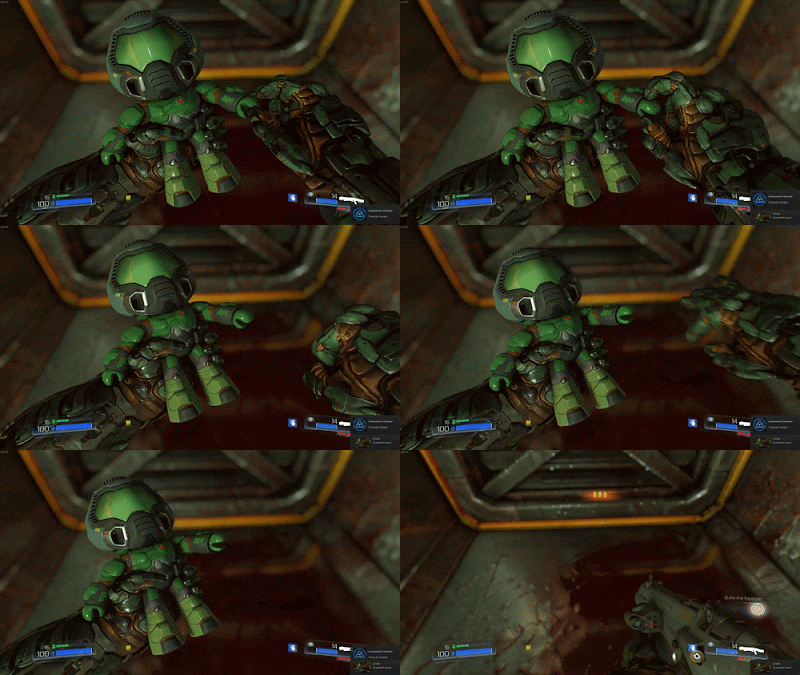
Hey little buddy. DOOM pushes you to collect 'em all.
PS: Try dying in lava. You won't regret it.
While I mostly enjoyed the large map size, it did pose a few gameplay problems. Getting around these large maps, especially when on the hunt for collectibles, can take quite a while and involve a lot of backtracking. This wouldn’t be a huge issue if not for how valuable some of these collectibles are. Without thoroughly searching the map, the player cannot fully upgrade their weapons, suit, or character by the game’s end. On the “Hurt Me Plenty” difficulty I never had too tough a time killing my foes, but I also maxed out my character whenever I could. For less experienced players or on harder difficulties, the reliance on finding secret items to fully power up your Doom Marine could pose a problem. Further, poor map design in a few of the entrenched encounters I described earlier was a bummer. Verticality is a key feature for these encounters, but I found several instances in which there was simply too much. Several common demons are fond of running away from the player, and when a map is too large and too vertical, it can be hard to chase them down. The result is a frustrating game of cat and mouse that drags these encounters down. And speaking of underwhelming encounters, DOOM features a small handful of bosses and none of which are particularly exciting or memorable. The final boss, for example, was laughably easy and felt like a strange note to end on for an otherwise extraordinary experience.

I cannot properly review DOOM without mentioning how absolutely stunning its visuals are. DOOM is a gorgeous game. Id Software blew me away with how crisp and detailed everything is, from guns to demons to environments. Despite lacking in geographic diversity, I loved looking at the different Mars facilities, the planet, and the handful of Hell zones I was taken to. The visuals are complemented by a gritty metal soundtrack that perfectly kicks in during heated battles. When I find myself stopping to admire the scenery and take screenshots, I know a game nails its presentation.

She's a looker alright.
At the year’s start, I had little to no interest in playing DOOM. How could it encapsulate that perfect “Doom” experience in modern setting? I am so happy to be proven wrong. Id Software made a fantastic hybrid of old and new that touts some of 2016’s best raw gameplay. My experience hasn’t really stuck with me, and I’m not too sure why, but it does not change the fact that I had one hell of a good time playing through DOOM.

DOOM
4/5

Monday, July 25, 2016

TIF Plays: Week of 7/18-7/22
Gameplay

Welcome to the The Impact Factor's last week of gameplay! Check out below to links of all my gameplay. Be sure to catch me live on Twitch (MegalodonPhD). I stream every Tuesday and Thursday at 5:30pm PT. Plus some special Friday streams, too! You can do me a favor by subscribing to The Impact Factor's YouTube channel, but hey, don't let me tell you what to do! 

To keep up to date with everything The Impact Factor, and me, follow me on Twitter: @alexsamocha

See you all next week!


Monday, July 18, 2016

TIF Plays: Week of 7/11-7/15
Gameplay

Welcome to the The Impact Factor's last week of gameplay! Check out below to links of all my gameplay. Be sure to catch me live on Twitch (MegalodonPhD). I stream every Tuesday at 5:30pm PST and Thursday at 6:30pm PST. Plus some special Friday streams, too! You can do me a favor by subscribing to The Impact Factor's YouTube channel, but hey, don't let me tell you what to do! 

To keep up to date with everything The Impact Factor, and me, follow me on Twitter: @alexsamocha

See you all next week!


Monday, July 11, 2016

TIF Plays: Week of 7/4-7/8
Gameplay

Welcome to the The Impact Factor's last week of gameplay! Check out below to links of all my gameplay. Be sure to catch me live on Twitch (MegalodonPhD). I stream every Tuesday at 5:30pm PST and Thursday at 6:30pm PST. Plus some special Friday streams, too! You can do me a favor by subscribing to The Impact Factor's YouTube channel, but hey, don't let me tell you what to do! 

To keep up to date with everything The Impact Factor, and me, follow me on Twitter: @alexsamocha

See you all next week!


Monday, July 4, 2016

TIF Plays: Week of 6/27-7/1
Gameplay

Welcome to the The Impact Factor's last week of gameplay! Check out below to links of all my gameplay. Be sure to catch me live on Twitch (MegalodonPhD). I stream every Tuesday at 5:30pm PST and Thursday at 6:30pm PST. Plus some special Friday streams, too! You can do me a favor by subscribing to The Impact Factor's YouTube channel, but hey, don't let me tell you what to do! 

To keep up to date with everything The Impact Factor, and me, follow me on Twitter: @alexsamocha

See you all next week!


Monday, June 27, 2016

TIF Plays: Week of 6/20-6/24
Gameplay

Welcome to the The Impact Factor's last week of gameplay! Check out below to links of all my gameplay. Be sure to catch me live on Twitch (MegalodonPhD). I stream every Tuesday at 5:30pm PST and Thursday at 6:30pm PST. Plus some special Friday streams, too! You can do me a favor by subscribing to The Impact Factor's YouTube channel, but hey, don't let me tell you what to do! 

To keep up to date with everything The Impact Factor, and me, follow me on Twitter: @alexsamocha

See you all next week!


Monday, June 20, 2016

TIF Plays: Week of 6/13-6/17
Gameplay

Welcome to the The Impact Factor's last week of gameplay! Check out below to links of all my gameplay. Be sure to catch me live on Twitch (MegalodonPhD). I stream every Tuesday at 5:30pm PST and Thursday at 6:30pm PST. Plus some special Friday streams, too! You can do me a favor by subscribing to The Impact Factor's YouTube channel, but hey, don't let me tell you what to do! 

To keep up to date with everything The Impact Factor, and me, follow me on Twitter: @alexsamocha

See you all next week!


Sunday, June 12, 2016

TIF Plays: Week of 6/6-6/10
Gameplay

Welcome to the The Impact Factor's last week of gameplay! Check out below to links of all my gameplay. Be sure to catch me live on Twitch (MegalodonPhD). I stream every Tuesday at 5:30pm PST and Thursday at 6:30pm PST. Plus some special Friday streams, too! You can do me a favor by subscribing to The Impact Factor's YouTube channel, but hey, don't let me tell you what to do! 

To keep up to date with everything The Impact Factor, and me, follow me on Twitter: @alexsamocha

See you all next week!


Tuesday, June 7, 2016

The Cavalry’s Here
Review
Overwatch, Blizzard Entertainment (PS4)

AbstractOverwatch is the most fun I’ve had with a multiplayer first-person shooter in a decade. The game is not only a love-letter to a long lineage of arena shooters, Overwatch also brilliantly adapts elements from MOBAs and fighting games to create an experience we’ve never quite had before. Overwatch is Blizzard doing the impossible, refining a well-wrought genre to near perfection. Unobtrusive but compelling lore supports a fantastic and diverse cast of heroes. Overwatch’s gameplay excels where others fail in its legibility, tactility, and rewards for players of all styles and skill. Overwatch is the epitome of fun, light enough to play casually with mechanical complexity that supports pro-level play. Despite high expectations Overwatch blew me away. It is not one to be missed.

The world could use more heroes. Well, one hero actually. And that hero is Overwatch. I was skeptical at first. The team at Blizzard is talented, but making its first new IP in over 15 years a first-person shooter? A genre that’s nearly been done to death? Where could they find novelty, and where could they optimize a nearly perfected formula? That’s a big ask. Especially for me, someone who had all but completely moved away from competitive FPS games in the past six years or so. But here’s Overwatch and it’s fantastic and I cannot stop playing.

Overwatch is an online team-based first-person shooter. Without a campaign or other single player content, Overwatch relies on a variety of sources to establish its game world.  Aside from a bare bones introductory cinematic, the majority of the world building is done through the characters and maps. Biographies and in-game quips between the game’s 21 characters shed light onto a fully realized world, an Earth in the near future that’s wholly unlike our own. Robots known as Omnics rose up against humanity, leading to a global war known as the Omnic Crisis. A team of talented individuals was assembled to fight the Omnics and take back the Earth – this group was called Overwatch. After winning the war, however, internal disagreements and a shifting public image led to the disbandment of Overwatch, scattering its eclectic cast of heroes across the world. Now 30 years later the world is once again in peril, and heroes old and new must lead the fight against the forces of evil.

The premise is merely an excuse to assemble a vibrant cast to duke it out across the world, however, and has little bearing on the game itself outside of environments and personalities. For example, the game’s lore doesn’t stop a team of six players from all picking Reaper and going shotgun crazy against a team of three Mercys and three Tracers. After all, for as grave as the story might seem, Overwatch couldn’t be further from it. Overwatch’s world and characters are poppy, colorful, and full of life. The story and character bios provide just enough to make traveling to the different maps interesting and to fuel character loyalty. I would love to see more story in the future as I have gone deep into the lore rabbit hole, but for now it provides a sufficient narrative framework upon which the game stands.

The lore gives a good reason why a transforming robot would square off against
a rocket-propelled hammer-wielding German, believe it or not.
The game’s core is its characters and that is where Overwatch knocks it out of the park. Before the game was even released communities formed up around specific characters, a testament to the remarkable design finesse that went into each and every hero. In a marketplace flooded with hero-based games, it was surprising that I could identify and name the entire roster with little study. Overwatch’s cast is diverse and fascinating. From the time-zipping Tracer to the pro-gamer turned mech pilot D. Va to hook-wielding Mad Max inspired Roadhog, no two characters are alike. Aesthetically, thematically, and most importantly gameplay wise, every single character brings something new to the game. Characters are divided into four general roles: Attacker, Defender, Tank, and Support. Attackers are generally your damage dealers, defenders help control the combat space, tanks block damage and supports bolster team performance. Within each role, however, the variety is astounding. Take support, for instance. The four heroes in that category are dramatically different, not forced to simply be back-line healers. One can create teleporters and defend objectives with laser turrets, another can attach healing orbs to allies while attaching debilitating orbs to enemy players. This diversity keeps matches fresh, as no two team combinations work exactly the same way.

What a fantastic cast of characters.
More impressively, every single hero is fun to play. It’s a truly noteworthy accomplishment. Never before have I played a character-based or hero-based game in which I’ve found enjoyment from literally the entire cast. I never thought in a million years I would like the Hot Topic steeped Reaper or the epitome of middle school cool Genji, but here I sit with the latter as my most played character. In so many ways Overwatch reminds me of my favorite fighting games, but I think the comparison that rings the most true is Super Street Fighter IIOverwatch’s heroes are world warriors, representing countries and combat styles. Mastering Overwatch’s cast is like mastering fighting game characters in all the best ways. There is so much nuance to each, from styles of play to skill ceilings to everything in between. I’ve sunk nearly 30 hours into Overwatch already and I have barely scratched the surface to truly understanding the strategic and skill depth for any of the game’s heroes.

When looking at a gameplay perspective, it was initially hard to put into words what exactly I found so engaging about Overwatch. At a surface level, Overwatch is a fairly standard first-person shooter with no real innovations when it comes to game modes, styles of play, map design, etc. It was a problem shared between myself and many in the game criticism community – people knew they were loving Overwatch but weren’t sure exactly why. Upon reflection, I’ve decided upon three key design decisions that make Overwatch a superior shooter. They are legibility, tactility, and rewarding play.

This is so much fun, but why? Legibility, tactility, and rewarding all players is why.
Everything about Overwatch’s gameplay is crisp and clear. First-person shooters often devolve into illegible chaos, with death coming from unexpected angles and objectives lost to the muddiness of combat. At all times during a match, Overwatch makes it clear to the player what to do and where to go. From colored directional lines unobtrusively found on the ground to great map design, Overwatch communicates its objective based gameplay clearly. The legibility extends to characters, too. Hero silhouettes are distinct, so even at the most cursory glance you know who you’re dealing with. Ultimate abilities come with an audio cue like “It’s high noon” or “Justice rains from above” letting you know what the enemy is doing and how you should react. Audio cues are distinct between teammates and opponents, too. Player health indicators make it clear to support who to heal, the minimal HUD heightens map awareness, and bold player outlines make it clear who is friend or foe. From team composition to objective play to character choice to character counters, Overwatch keeps it simple and makes it obvious. It’s fantastic.

Overwatch is also an incredibly tactile game. This is something Blizzard really excels at, adding a physicality and weight to the game that makes it a joy to play. Character abilities have the appropriate visual and audio flare so that even the most mundane of actions feels powerful and is satisfying to perform. Sound design all around is incredible, adding a layer of substance to the world that moves it past feeling like a sterile 3D combat arena. Each of the characters’ weapons is fun to use, having clearly defined attributes like distance traveled or bullet drop. Fast matches reinforce this tactility. Never are you stuck in monotonous repetition. Each game of Overwatch gives you those endorphin boosts and aesthetic rewards so that you’ll be saying “just one more match.” Overwatch is crunchy (mechanics heavy), fluffy (lightness), and sticky (keeps you playing). Playing a match of Overwatch is a textural treat for your mind that leaves a long lasting flavor.

Overwatch is a sensorial experience from its most mundane moments to its
most action packed.
The game’s most remarkable design innovations are evident in rewarding the player. Overwatch is probably the most player-friendly first-person shooter I’ve ever played. No matter your style of play, defensive or aggressive, or how well you play, terrible or spectacular, Overwatch lets you know what you did well. A mid-match menu that shows you at the bottom of a list of players or with a sub 50% kill to death ratio is nowhere to be found. End of match statistics display personal bests, as well as if you’re in the top three in your team in eliminations, healing, or blocking. If you damage an enemy at all you get a kill ping when they go down, not just for the player with the final blow. In-game gestures can be used in the place of audio chat, limiting toxicity. Overwatch highlights one Play of the Game at the end of each match, showing off multikills and other skillful play. Players are encouraged to stay in the same lobby for multiple matches via a consecutive match experience bonus, helping to build familiarity with the players and get a feel for how they play. Up to four players have their performance highlighted in-between matches, showing off their accomplishments like highest accuracy or most objective time. You can vote for a player of your choice, giving them extra commendation as well as increasing your chance to have them on your team next match.  Heroes’ ultimate abilities charge mostly irrespective of player performance, so unlike kill streak bonuses from games like Call of Duty, everyone gets to enjoy unleashing crazy powerful attacks. And the list goes on from there. I wrote last week that Overwatch is the epitome of fun and I stand by that. So many small design decisions synergize in a way that create one of the most friendly and enjoyable multiplayer experiences I’ve had in a decade.

Getting a Play of the Game feels oh so good.
Overwatch’s clear design strength helps to mask an admittedly content light final release. Unless you like playing against fairly incompetent AI, the game offers only two modes of play at the moment. The weekly brawl, in which the game’s rules are modified, is a nice addition to the standard Quick Play mode but doesn’t really bring much extra to the final package. Overwatch only has three kinds of match types, too: Payload, Control and Capture. Extra styles of play would have been nice, though something like Team Deathmatch or Free For All would not work with Overwatch’s role-based heroes. Player progression is aesthetic only. You receive a blind item loot box each time your profile levels up. Loot boxes contain cosmetic items like character skins, sprays, voice lines, and emotes. As someone who loves distinguishing themselves via cosmetic customization, I’ve had a blast collecting and equipping these items. I appreciate that all unlocks are aesthetic only, so no one player has an advantage because she managed to open a great gun in her random box. Still, it will be interesting to see if these cosmetic rewards keep me engaged for the long haul. Perhaps what will keep me coming back is just how much fun the game is to play? Shocking, I know.

I keep coming back for games like this one. Overwatch is incredible. 

As I wrap up the review, I still feel like I’ve fallen short on communicating exactly why Overwatch is so phenomenal. Suffice to say, Overwatch is greater than the sum of its parts. Blizzard has done the impossible, refine and simplify the team-based first-person shooter to perfection. Everything just works. Overwatch is a blast played solo and it’s even better with friends. Overwatch is fun to play for fun and great to play at a highly competitive level. High skill ceiling characters keep me coming back to get better, and low skill floor characters are perfect for quick casual matches. If history is any indication, Overwatch is the platform for much more to come. And what an absolutely stellar platform it is. Watch out other games, the cavalry is here.

Overwatch
5/5

Tuesday, March 1, 2016

Evolutionary Imperative: Conserved Building Blocks in Biology & Games
Article, Parallels

Abstract: Biology and games have a lot in common. Conservation and iteration are at the heart of both. While not necessarily bad, conservation can lead to adverse effects. In biology, utilizing minimal components reduces resource consumption, but results in biological processes prone to perturbations as well as presents serious obstacles to curing human disease. In games, building upon a genre’s well-established mechanical foundation is efficient and effective at creating functional gameplay, but an overreliance on iteration has led to stagnation in new genre creation and a repetitive AAA gaming experiences. Hybrid genres and a rapid evolution in the independent scene, however, has ameliorated some of gaming’s conservation pitfalls.

The world’s most intricate complexity is built upon a simple foundation. When you boil a process, a system, or an object down as far as you can, you’re left with relatively simple building blocks. Blocks that have been long established as fundamental to the existence of the more complicated thing it constitutes. As you my beloved reader know well, I’m a biological scientist first and games writer/podcaster/personality second. I’m always looking for parallels between my two biggest passions, as disparate as they might seem. A particularly stimulating lab meeting prompted me to quickly jot down an idea for parallels. That idea? Conservation. This article will touch on some examples of conservation and potential adverse affects in both biology and games.

Biology, games, and perhaps all life has a conservational imperative—to utilize what has been previously established in a myriad of ways. Speaking first of biology, it is remarkable that life on Earth exists at all. The spontaneous formation of RNA, into DNA, into proteins in the primordial soup of early Earth is one of the most intriguing events in the world’s history. A lot of work (i.e. random events happening in ideal conditions that primed for the formation of) went into the generation of life’s building blocks. All living organisms stem from this origin point: the formation of Earth’s first RNA molecule. The hundreds of millions of years of evolution have operated using life’s most basic building blocks: RNA, DNA and proteins. Human life, if reduced and oversimplified as much as possible, is just the right combination of the three. But even if you were reduce less dramatically, a variety of different biological processes rely upon a simple foundation to enact their complex functions.

You would think would be better images for "primordial soup."
You would be wrong.
My recent experience in a predominantly immunobiology research laboratory offers me a specific perspective on this phenomenon. The human immune system is notoriously complex. The delicate dance between antigen presentation, MHC complexes, myeloid cell recruitment, germinal center formation, and T-cell single positive selection is mankind’s defense against an invasive microbial world. Understanding how our immune cells communicate not only with each other, but with pathogenic material, is essential to our understanding of and fight against a number of human diseases. Studying the immune system is not without its complications, however, not the least of which relates to this notion of ‘conservation.’

Biological processes, immune response included, are based upon the creation, recruitment, and activation of proteins. Cells are made of proteins, signaling molecules are frequently proteins, etc. Proteins are so important that even as recently 80 years ago, scientists believed proteins were the genetic material of life (we now know that DNA is our genetic material). What might surprise you is that there are only 21,000 protein coding genes in the entire human genome.  That’s 1% of our total DNA. Life is excellent at conserving our biological and genetic resources as much as possible—the fewer kinds of proteins you have to make to carry out different functions, the less energy / resources your cells spend to get their job done. It’s about efficiency. What that means in terms of specifics, be they organs or processes or otherwise, is that a large majority of our protein building blocks have multifaceted roles. Sometimes a particular protein will act in a variety of similar ways in different processes, but other times it can be a little bit (read: a lot bit) more complex.

If you think 21,000 proteins is few, what about nucleotides?
DNA is made up of just 4.
There are a number of examples in biology where the same protein can have multiple and opposing functions. This is great for the body as it conserves resources, but can be both confusing and bad for human health. Immune proteins are a perfect example of this phenomenon. Let’s take one of my favorite immune proteins, interleukin-2 (IL-2). IL-2 is a cytokine protein secreted by immune cells, which can bind to specific receptors on immune cells to stimulate inflammatory responses. In fact, IL-2 is just one of many interleukin proteins that are key regulators of immunity, as they bind and activate/suppress immune cell activity. But IL-2 is of particular interest because it was first identified as a potent anti-inflammatory protein. This is important because a number of terrible human diseases occur as a result of an overactive immune system, like sepsis and autoimmunity. IL-2 functions to stop effector T cells, a workhorse cell of the human immune response. It was hypothesized that IL-2 administration would act as a wonder drug for these hyperimmune conditions. But that wasn’t the case. In fact, in nearly all cases, giving patients IL-2 made their hyperactive immune disorders worse. Why? Well, it turns out that IL-2 has more than one function. Sure, it helped to block effector T cells. But it also activated regulatory T cells. Once activated, these “T regs” induce an even more pronounced immune response. Which would then worsen the illness. Ouch. And this phenomenon isn’t unique to immune cells or interleukins. In nearly all biological processes we’ve identified proteins with dual opposing functions, complicating not only our understanding of said processes but also making it increasingly difficult to find ideal approaches to treating human disease. Though biologically efficient, conservation has serious pitfalls.

You do too much, IL-2. Seriously. Too much.
I’ve seen a similar evolution in video games. Certain ideas took hold during the early and primordial days of game development that still act as the basic building blocks of modern games. Games emulate biology in how strongly dependent they appear to be on a limited number of essential elements, whose origins nearly all go back to the earliest days of household gaming. It’s fascinating to see the macrocosm of carbon-based life recapitulated in the microcosm of evolution in a roughly forty-year-old industry. Developers rely on these building blocks in much the same way biology relies on RNA/DNA/protein—they work and they’re efficient. For example, much of the foundation for what a 2D platformer is was laid out in 1985 with Super Mario Brothers and again in 1988 with Mega Man 2. The building blocks for a first person shooter were established by DOOM in 1993. Or adventure games with King’s Quest in 1983. Or real-time strategy with Dune II in 1992. A handful of titles like these indelibly shaped what we perceive of as video games and still serve as the foundation for most games we see today.

Call of Duty has DOOM DNA. DOOM proteins.
Are game developers wrong to repurpose the groundwork laid before them to make their own titles? Absolutely not. That’s nearly as ridiculous as blaming a stomach cell for using the same DNA as a brain cell. The conservation we see in games can be a little disheartening at times, however. Because some of these building blocks are so strong, so good at what they were desigedn to do, we’ve seen decades of the same kinds of games being made. Each game possesses its own identity, sure, but especially on a mechanical level games in the same genre can often feel very similar to play. Gears of War and Binary Domain and Uncharted are all great, but their cover-based 3rd person shooter combat all left me feeling a certain way. The same way. In part because their gameplay is all based upon the same foundation (Kill Switch, 2003).

Conservation, while not inherently a bad thing, has put AAA game development in a tough (and uninteresting) spot. Big budget game development is totally shackled by established gaming conventions of the past decade or so. While fun and functional, Call of Duty and Battlefield do little to reinvent themselves or the genres they represent. Assassin’s Creed, once established as a brand people care about, has done little more than lightly iterate on the basic 3rd person action open world foundation since Brotherhood. Exceptions do exist, but playing most AAA games gives the player a sense of sameness, of repetition, that exists in part due to an over-reliance on mechanical foundations.

A little too much conservation, Assassin's Creed. Maybe that is why
the franchise is taking a year-long hiatus.
Innovation on a macro (genre) level has traditionally been slow, in part because games are such an iterative pursuit. Ideas are conserved, ‘improved’ upon, and then re-released. Instead of seeing new genres, you’re much more likely to see new hybrid genres pop up. Or at the very least, that’s what we have seen in the industry recently. There’s the first-person shooter, RPG, loot hybrid with Borderlands and Destiny. The rhythm roguelike hybrid Crypt of the Necrodancer. The rhythm visual novel hybrid Persona 4: Dancing All Night. Or even the real-time strategy fighting game hybrid genre—MOBAs (a topic for another time). These syntheses can create something new, like in biology, though not ‘new’ in the truest sense of the word.
 
Crypt of the NecroDancer was a combination I had never seen before.
And oh did it work so well.
Unlike biological evolution, however, games have made great strides in the past few years to reanalyze this conservational approach. Game developers, predominantly in the independent scene, have been working to make games that aren’t as reliant on gaming’s long established building blocks. The very definition of games has been evolving, expanding, to include a much wider swath of interactive experiences. Take Robert Yang’s Stick Shift, in which the player engages with homosexual intimacy via operating a car’s manual transmission. Or Fernando Ramallo's Panoramical, a game in which you compose visual art and music simultaneously and in-real time. Panoramical has learned from the long lineage of game development, but has created something we’ve never seen before. As one game personality put it: Panoramical is the future. Many of these experimental games can be found on itch.io, a font of creative work from independent developers who have moved away from conservation & iteration in their titles.
 
The future? Who knows. But Panoramical has me excited.

Conservation makes sense, but it is not without its downsides. What is efficient and effective may not always lead to the best outcome, be they for human health or creating compelling video games. At least evolution is relatively quick in gaming. Biology is working on that, though. It makes me excited for the future, for both games and biology. There’s a lot on the horizon.