Showing posts with label PS Plus. Show all posts

Tuesday, July 12, 2016

Feel The Fury
Review
Furi, The Game Bakers (PS4)
Abstract: Furi is a neon-soaked, electronic flurry of blades and bullets. A unique visual, aural and gameplay package, Furi confidently establishes itself as something you’ve never quite played before. As a boss-focused action combat game, Furi succeeds in a number of ways. The hyper fast combat, replete with skill intensive dashing, parrying, and attacking mechanics, plays wonderfully. Furi demands a lot of players and brutally punishes mistakes. Unfortunately, not everything in this diverse package works well. Bullet hell sections suffer from unclear projectile and player hitboxes that frustrate to the point of feeling unfair. Painfully slow and barren walks between boss fights leave the player bored. Taken together, however, Furi’s successes outweigh its failures to create a game well-worth playing for action fans.

Released for free as part of PlayStation’s July PS+ line-up, Furi is a new game from The Game Bakers that has its toe dipped deeply into Blade Runner, Tron and shonen (boys) anime. Furi is a wild ride, a breathless series of fights that test the true mettle of the player. Prepare yourself – it’s about to get furious.

The game starts with a prisoner shackled in a cell as a masked jailer is torturing him. Your protagonist, The Stranger, is silent. He neither knows where he is or why he’s there. As the jailer leaves you are greeted by a mysterious companion, a rabbit mask toting specter known as The Voice. The Voice frees The Stranger and informs him of the brutal journey ahead. The Stranger must fight through the most intricate, and deadly, prison ever built as he makes his way to the planet floating below. This is no easy task, as terrifying characters guard each floor: the guardians of the prison and bosses he must vanquish. As you move from floor to floor, The Voice slowly sheds more light on his motivation, who The Stranger might be, and who are the people trying to stop you.

Admittedly, the story is quite light. Motivations and the truth of your situation are revealed quite slowly. Questions are answered with more questions and much is left up to the player to interpret. The narrative framework for the game at hand, however, works well. Games don’t often need much to propel players through a serious of huge boss fights, and the same is true for Furi. What works best about Furi’s story is its establishment of a wholly unique world. The game’s credits cite game designers like Hideo Kojima and Goichi Suda as inspiration for creating Furi. It’s abundantly clear throughout. Furi’s world is like no other I’ve seen in a video game. The mixture of space with samurai with cyberpunk is perfect. From start to finish I was engrossed in Furi’s world. I only wish there was more to explore.
 
The Voice, The Stranger, and one impossible goal.
As you might have guessed, Furi is all about its combat. Furi is a “boss rush” game, meaning that the large bulk of the gameplay is spent fighting Furi’s 10 bosses. You move from one boss to the next with very little in-between. Furi would suffer if its bosses were bland, repetitive, or uninteresting, but that couldn’t be further from the truth. Each fight is different, testing the player in a variety of ways so they can prove their mastery of the game’s various systems. Each fight takes place in an arena, but no two arenas are alike. Bosses are visually striking and impressively memorable. You experience a fantastic sense of dread as you walk into the arena for a new boss. What new challenge are you about to face? Fights can take anywhere between 5 and 45 minutes, depending on player skill and the boss being fought. My completion time was about six and a half hours, though looking at leaderboards some have completed Furi in as little as 45 minutes. As I’ll explain in great detail, Furi is all about player skill.

Each boss fight is a unique combination of Furi’s three central mechanics: third person isometric arena fights, 3D fighting-game styled close combat, and bullet hell. Let’s talk about the first. The arena-based isometric fighting is superb. Bosses hurl attack after attack at the player: projectiles, area of effect moves, and close combat. Furi follows along with the recent trend we’ve seen in games like Hyper Light Drifter and Stories: The Path of Destinies in which movement speed and dodging are the key focus. The Stranger moves fast. Incredibly fast. Furi emphasizes use of your dash move, a quick teleport with invincibility that serves as both your primary way to avoid being damaged as well your method for getting close enough to the boss to attack. Like all combat mechanics in Furi, the skill ceiling for this dash move is quite high. The dash button can be held down. The longer it’s held down, the further your dash goes. Timing your dash and knowing how far to dash make all the difference. When dashing isn’t an option, you can parry. Parries only work on certain attacks, like projectiles and melee strikes (as indicated by a visual flash and a distinct sound) and need to be timed perfectly to prevent damage. A well-timed parry blocks the enemy’s attack and restores health to your character. A perfectly timed parry leaves the boss open for a huge counter-attack. Learning to use your parry is challenging but immensely rewarding (and essential for the game’s later bosses). Similar to the dash, it too has a high skill ceiling. Furi is all about mastery.
 
The Chain is the first stop in a long line of brutal bosses.
Attacking bosses is just as skill intensive. You typically have two options for dealing damage while in the isometric arena combat. You can fire a laser pistol with the right analog stick at the boss. For some bosses, this will chip away at their health bar. Others can block or ignore the pistol damage entirely. The bulk of your damage comes from sword attacks. After parrying or otherwise opening up a boss for attack, The Stranger can unleash a four-hit combo. Depending on your window of opportunity, sometimes you can get all four hits and sometimes just two or three. Much like dashing and parrying, Furi allows the player to perfectly titrate how they attack. The pistol can be charged by pressing another button, which unleashes a powerful knock down attack against the boss, but it can be incredibly hard to connect with the shot. You can also hold down the sword slash button, which similarly charges a difficult to connect but powerful knock down attack. Dealing damage is all about finding your enemies’ weak spots and exploiting them. Like many great combat focused games, Furi has a delicate but fantastic balance of risk with reward. Do you try for that extra damage knowing you could be punished? Or go the safe route but risk spending longer in the fight thereby increasing the odds you mess up a dodge and die? Furi is steeped in difficult split second decisions that test dexterity, reflexes, and pattern recognition. I loved it.

Dashes, parries, melee punishes. Combat in Furi is fast and fabulous. 
Typically, by the time you’ve dealt enough damage to the boss’ health bar (they have several) in the isometric arena, they’ll fall. This exposes them to a quick melee hit that cinematically shifts the combat into a 3D fighter styled brawl. Here, it’s no longer about enemy projectile attacks or area of effect moves: it’s all about melee combat. Trapped in a much smaller zone, you have fewer options to escape your enemy’s blows. Quick dodges and parries are critical. This zoomed-in fight is the perfect culmination of that boss phase, and the way the camera dramatically shifts makes the player feel so empowered. One of my favorite fights in the game, The Edge, is entirely fought in this 3D fighter style. It’s so cool. It takes the mechanics you use from the isometric viewpoint and reformat them in a new and compelling way. And typically, after you down a boss in this perspective they shift to their next phase, meaning a new health bar and new attack patterns. Like the isometric viewpoint, this fighting is again all about pattern recognition, risk and reward, and perfect execution.
 
The zoomed-in melee clashes never stop making your feel awesome.
Just in case it isn’t abundantly clear by this point in the review, Furi is not an easy game. Furi is brutal, punishing players for even the smallest of mistakes. Though the game (usually) communicates what the player needs to do to defeat the boss, actually doing so is another thing entirely. The player only has 3 health bars. Get K.O.’d three times and you lose – you need to restart the entire fight. Destroying one of a boss’ health bars restores one of your own, but this only goes so far when the boss’ last few phases can devastate the player. I consider myself fairly skilled at games with combat like Furi’s, and even I typically took 2-3 attempts to beat a boss. This can sometimes be an exercise in frustration. Going back to the very beginning of a 40 minute fight just because you died to attack patterns you had never seen before isn’t super fun. This difficulty is compounded by the fact that Furi offers very small windows for both dashing and parrying. Mess up your parry timing by even a quarter of a second and you could be looking at losing a third of your current health bar. With all that said, I enjoyed Furi’s difficulty as it relates to isometric and 3D fighter combat. I love tough games when they’re fair. Furi, for the most part, nails that fair toughness.

Unfortunately, not all mechanics achieve the same degree of success. Namely, the bullet hell segments. I’m someone who loves a good bullet hell. They aren’t great here. Bullet hell segments take place from the isometric viewpoint, which poses a serious perspective problem. It’s hard to know exactly where the projectiles are or where your character’s hitbox ends. There is a reason most (good) bullet hells are top down or 2D. Getting hit by a projectile you’ve anticipated and dodged feels awful. This problem could have been mitigated in a couple of ways, but the most obvious of which is it make projectile boundaries more clearly defined. Like with a bold, dark outline for instance. Instead, projectiles are bright amorphous blobs of energy with fuzzy boundaries. While some bosses have limited bullet hell sections, like The Chain or The Scale, others rely on this mechanic for their entirety. Because of it, The Line and The Burst fights become painful to complete. Even more egregiously, Furi’s final final-boss is entirely bullet hell making it the worst fight in the game.

The fourth or fifth time you get hit by a projectile you were SURE
you dodged can really suck the fun out of the fight.
The problems don’t end with bullet hell segments, however. Outside of fighting bosses there is nothing to do. Normally this wouldn’t be a huge issue. I am more than ok with a game focusing on what works – Furi didn’t need anything more than boss fights. The player, however, needs to walk from one fight to the next. I appreciate what The Game Bakers try to do with these sections. Slowly walking gives The Stranger that badass feel. It also gives The Voice time to build upon the narrative and show off the game’s unique world. But the walking is so slow. With nothing to do other than push the stick in the direction you want to go walking becomes painful. A walk from boss A to boss B can take upwards of 5+ minutes. Slowly moving your character through barren, linear pathways is not fun for 5+ minutes. It’s not fun for 2. To make matters worse, sometimes it isn’t exactly clear which way to walk. This can result in walking several slow minutes in the wrong direction, adding to your snail’s crawl to the next fight. The walking problems are compounded by Furi’s decision to use fixed cameras along your path. Transitioning between one angle and the next messes with your directional controls. Furi tries to keep it consistent, like if you were holding down on one screen and the next you’re moving up holding down will still move you in the same direction, but it gets messy. Each new screen I would stop my character and reset which way I was holding the control stick just so The Stranger wouldn’t awkwardly stutter or walk into invisible walls.
 
I have one fear: having to endure the next overlong walking sequence.
Slow walk and chaotic boss fight alike are accompanied by a stellar electronic soundtrack. Furi has one of the best soundtracks of the year. The game features the works of several artists, like Carpenter Brut and The Toxic Avenger, that synergize with each other to reinforce the mood set by the combat and visuals. The pulsing beats get you pumped up and ready to take on the world. When combined with the cool character designs, great cell shaded look and diverse visuals, Furi is a complete aesthetic package that bolsters the entire experience.

Furi is a game with high highs and some low lows, but one that I can’t help but be enamored by. I want to return to the sci-fi samurai 80’s neon world to inflict havoc on the game’s fantastic bosses. I also feel the urge to better myself, to achieve the elusive A and S Ranks on the fights, or even complete one without taking damage. Furi is, for better and worse, very much its own thing. Furi is one prison I wouldn’t mind being trapped in again.

Furi
3/5

Saturday, November 7, 2015

TIF Plays: Dragon Fin Soup!
Gameplay

Dragon Fin Soup is a new strategy RPG roguelike hybrid from developer Grimm Bros. The trailers caught my eye so I decided to give it a whirl on stream. Plus it was free this month for PlayStation Plus users. On top of all that, I love both RPGs and roguelikes. The combination of the two was too intriguing to pass up! The result was a bit better than expected! Check out an archive of my stream linked below, and be sure to catch me when I go live by following me on Twitter (@alexsamocha) and Twitch (MegalodonPhD) Enjoy!

Tuesday, October 20, 2015

Retrieval Mission
Review
Xeodrifter, Renegade Kid (PS Vita)


Abstract: Xeodrifter is about retrieval, both mechanically and narratively. Renegade Kid’s 2014 action-adventure game takes the ideas established by games like Super Metroid and Castlevania: Symphony of the Night and implements them to great effect in Xeodrifter. For brief moments, I felt the same thrill I experienced when I first played those seminal, genre-defining games. At others, the game’s limited scope reminded me I was playing a title with a different ambition than it’s forefathers. The game is fun, functional and well made but doesn’t have much of its own voice.

Xeodrifter’s premise is simple enough. You play as an astronaut who, after a collision with an asteroid, finds his ship critically damaged and unable to continue lightspeed travel. The astronaut is then subsequently stranded in a small solar system of four planets, tasked with traveling down to each in search of the components to repair his derelict vessel. On each planet you find challenges—small monsters, traps and difficult areas to traverse. As you progress through your short time with the game, you will find yourself frequently hopping between planets as you become better able to explore them. By the end of your adventure the astronaut barely resembles his starting self. You have the ability to jetpack upwards, run at phenomenal speed, transform into a submarine, and more.

Submarine exploration is just the start of your journey.
It’s clear to me that Xeodrifter was made with longtime genre fans in mind. Everything has a place. The game felt immediately familiar, like returning home. Xeodrifter knows its pedigree and acknowledges the kind of people likely to play it. That manifests itself in a couple ways. First and foremost, Xeodrifter is not a game that’s going to hold your hand. You’re not told which of the game’s four planets to start on, that’s something you discover when you realize you can’t make progress in all but one. And even after that, it’s up to you know find where and how to use your new exploration abilities. Xeodrifter also has an exceedingly punishing first hour or so. You start the game with an extremely limited health pool. A couple hits and you’re dead. There’s no checkpoint system mid level either. You die and you’re sent back to the start of the world. I wouldn’t call Xeodrifter a difficult game, but it is certainly one that will make you pay for your mistakes. As a fan of 2D action-adventure games, and metroidvanias, it felt perfect.

Try not to get hit. Dying, at least at first, comes pretty often.
Xeodrifter’s 2D gameplay is kept simple. You run, jump and shoot. The former two aren’t done exceedingly well at first, though. As a metroidvania, a key aspect of your progression relies on unlocking new abilities that both open up new avenues of exploration and make your character feel more powerful. How do you gain these new abilities? Boss fights. Bosses test your understand of the game’s mechanics, as well as the use of all previously acquired power ups. Fights like these are often a high point in other metroidvania titles. That’s unfortunately not the case here. Every boss shares the same model, only with different colors. Though each fight proceeds a little differently (each new boss will have one or two new moves), they all play very similarly. It’s monotonous and the game’s biggest misstep. It would have been so nice if the repetition of visiting the same worlds several times over was in-part ameliorated by exciting boss fights.

Wait, you again?!
Like I said earlier, Xeodrifter is all about retrieval. Renegade Kid has retrieved the bare bone essentials from Super Metroid and repurposed them for the game. It felt as if the developers had a checklist of everything a metroidvania game needed to feel complete. They made sure to check all the boxes but, unfortunately, Xeodrifter doesn’t have much beyond that. Much of the criticism levied against Xeodrifter when it first released was that the game was ‘too short.’ Time to completion is never something that affects my review of a game, period. But there is a nugget of insight in that complaint. Xeodrifter is fun, functional, and well-executed. It also feels like it could have been more. The game is content to be a charming throwback to some of your favorite games, rather than try to strike out on it’s own and become a new classic. Xeodrifter felt like an appetizer to a more complete experience.

Straight out of Super Metroid. Not that that's a bad thing.
Renegade Kid can sure nail visuals, though. The game looks and sounds fantastic. Xeodrifter is a perfect fusion of 8- and 16-bit graphics. The end result is a game that would be at home among its NES/SNES inspirations. One of the most striking aspects of the game’s presentation is what the developers have adapted from their previous title, Mutant Mudds. A power up you unlock mid-game allows the player to hop between the foreground and background to traverse past obstacles. The way in which Renegade Kid pulls off this effect needs to be commended. The fidelity of the miniature background combined with the focus blur on the foreground that happens seamlessly between hops is remarkable. You could tell this was the developer’s signature. It never stopped being fun.

Background-foreground hopping was my favorite thing to do in Xeodrifter.
Xeodrifter filled a perfect niche in my game time. I was looking for a tightly designed, compact experience with solid mechanics and a competent foundation. All of that is true about Xeodrifter. The game felt at times like it lacked ambition, however, which was clear in the repetitive gameplay and uninspired boss fights. Still, I was happy with the time I spent with the game and would recommend it to anyone looking for a quick metroidvania fix. You’ll retrieve what you need from it.

Xeodrifter
3/5

Tuesday, September 22, 2015

Back To The Future
Review
Super Time Force Ultra, Capybara Games (PS4)

Abstract: Super Time Force Ultra is innovative, action-packed, and fun. The game lets you shoot your way through history's greatest hits, fighting alongside an army of your past selves. Super Time Force Ultra is an incredible accomplishment in game design. Exceedingly complex ideas and mechanics are made simple, creating moment-to-moment gameplay that's light, fast and frantic. The sometimes eye-rolling humor and weak boss fights were a bummer, but didn't detract too badly from the final experience. A wonderful aesthetic, great character design and high skill ceiling hooked me from the start. Super Time Force Ultra is a game I didn't put down until I beat. Give it a go.

Time travel can be complicated. Have a conversation with your future self, informing you that you’re going to become an intergalactic commander? Sure. Go back to the time of the dinosaurs to prevent their annihilation? Why not. See yourself get killed only to stop time, reverse it, come back and kill the thing that killed you? Yep. Super Time Force Ultra is here to tackle these big questions. And have a really fun time while doing so.

Super Time Force Ultra is a 2D shooter originally developed for Xbox One and PC by Capybara Games, the studio behind the incredible Superbrothers: Sword and Sworcery on iOS. The game was met with critical praise and, just on aesthetic alone, it quickly made its way onto my must-play list. Super Time Force Ultra finally made its way to PlayStation this month, included as part of the PlayStation Plus lineup of complimentary games. I knew it was finally time to time travel.

You play as a group of heroes, known as the Super Time Force, tasked with defeating the nemesis of fun: Dr. Infinity. The nefarious doctor stands in opposition to the central goal of the Super Time Force—to make history more interesting. That’s right. Under the leadership of Commander Repeatski, you’re tasked with going back to pivotal moments in Earth’s history to undo lame outcomes of the past and future. This includes a gamut of “nerd” favorite time periods. The Super Time Force is sent to the past to stop the destruction of Atlantis, to Earth’s future (that looks stunningly like a 1980’s imagining of the year 20XX) to stop oppressive robotic regimes, and to 199X to fight against an oppressive Mad Max styled wasteland. Along the way you grow your squad with new powerful heroes like Lou Don Jim, a rotund lightsaber wielding warrior, or Dolphin Lundgren, a gun toting fin-pedal dolphin. In each era you must fight the armies of Dr. Infinity who do their best to stop time from becoming more rad.
 
Where it all starts: Philly! (I went to college there, whoo!)
As I’m sure you can tell already, Super Time Force Ultra is a game with a heavy comedic slant. Everything that happens, from conversations to scenarios to character appearances, is kept light and fun. The playfulness Super Time Force Ultra’s world maintains the game’s cheerful tone throughout. I, however, was not particularly captured by the game’s style of humor. Filled to the brim with puns and tongue-in-cheek references to “nerd” favorite topics (like Star Wars or 80’s action films), Super Time Force Ultra tries really hard to be funny. No joke or pun is too terrible, but it came across as an attempt to appeal to a demographic I am not a part of. Although I didn’t find myself laughing at “insert time pun here,” the fun the developers had creating this world and characters is demonstrably clear. Super Time Force Ultra oozes charm. I’m not ashamed to admit I smirked at unlocking the Squirty Harry character, or nodded in pleasant acknowledgement of Jef Leppard. Where this fan-directed attention was most effective for me was the game’s inclusion of characters from the PlayStation wheelhouse. It was great blasting away enemies with President of Sony Worldwide Studios Shuhei Yoshida, the character from Journey, and The Order 1886’s crazy powerful Sir Galahad. Nothing feels better than blasting your enemies out of existence with a giant @yosp tweet.
 
A lot of jokes miss their mark.
The plot and characters are an important part of Super Time Force Ultra, but the game is really all about is blowing stuff up in spectacular fashion. Super Time Force Ultra plays like a mash-up of Contra with Braid. As a 2D shooter, the game feels very similar to your classic Contra titles. Moving and shooting is simple. You move left to right, occasionally navigating some obstacles with basic platforming, Your character can shoot in four directions: straight in front of you, up, down, and diagonally. You can do one of two attacks: quickly pressing the fire button will (usually) give a rapid firing but weak projectile, and holding down and releasing the fire button will give you a powerful super attack. For example, holding down the fire button on your starting operatives will give a rapid fire Gatling gun attack or a sniper shot the pierces through objects. The object of every level is simple: get to the end. The act of actually doing so, however, brings in the complexity.
 
Why is Shuhei blowing stuff up with tweets? Because, STFU.
Time travel mechanics are central to Super Time Force Ultra. You only have 60 seconds to complete a level, a task that would be fairly impossible if you played the game exactly like a classic 2D shooter. That’s where pausing and rewinding time comes in. At any moment the game allows you to freeze time, rewind it, and start over. For anyone who has played Braid, you’ll know the feeling I’m describing. But in Super Time Force Ultra, time travel has powerful advantages. When you restart time you choose a new hero. Those new heroes, or copy of the same hero, will spawn into the level and play alongside your past self. Each and every time you retry, you fight alongside your previous attempts. Your ghosts are still able to deal damage to enemies, destroy obstacles, and collect items. The longer you play a level, the more times you rewind time and drop a new hero into the fold, you’re growing an army of selves that all act in real time. The mechanic allows for thoughtful action, as each new life and each new section of the level is an optimization puzzle. I felt compelled to discover the best solution to advance through difficult sections quickly—like setting up a sniper at the back whose sole purpose is killing enemies, a shield-bearing character to block bullets, the nimble Shuhei to collect an item, and Sir Galahad to sprint quickly through the carnage. Each Super Time Force member adds new abilities to the fold. Finding the right combination of those skills to get you to the end of the level is brilliant and consistently engaging.
 
It's so much fun to strategize, optimize, and destroy
absolutely every single living thing in sight.
It’s not easy being a time hero, though. In fact, it can be quite difficult. The game encourages (reads: necessitates) use of its time rewind mechanic. The game is extremely punishing. Not only is 60 seconds not enough to beat the level without the assistance of your other selves, but also every single thing kills you in one hit. Touching enemies, running into their projectiles, traps, you name it. Moving through levels involves navigating dense bullet-hell sections that repeatedly kill the player. Frustration comes in large quantities but, for the most part, it only sweetens the reward when you clear a particularly challenging section. Time travel allows you to prevent your own past deaths, too. You’re able take out an enemy before they killed you on your previous run. Saving your past self coverts them into a collectible that powers up all your attacks and gives you an extra point of health. The tension this system creates is great. It pushed me to always be aware of all my past selves even if there were roughly a dozen of them going at once. Time crystals aid your journey. Three are scattered throughout each level. Collecting or shooting these crystals further slow down time, allowing the player to more efficiently clear out enemies or rush towards the level’s end. Regardless, going through each level is a sea of deaths and retries. The quick pace of the game and the generous number of attempts the game affords you, however, helps to balance out the challenge and maintain a consistent level of fun.
 
You're going to die. A lot. That's what time travel is for.
The only frustration that is largely unaddressed by these player-friendly systems are the boss fights. They just don’t feel right within the game’s systems. Some of the later bosses require a much more skillful optimization of your past selves, to the point where on one or two bosses I nearly ran out of time. I hadn’t done damage quickly enough at the start of the fight. There is a pure joy that comes out of watching all of your past selves eviscerate a boss in a matter of seconds, but the moment to moment gameplay of some late game bosses was not incredibly fun.
 
Some boss fights were great, others not so much. Pictured above: not so much.
I want to take a moment to acknowledge that Super Time Force Ultra is a remarkable accomplishment in game design. Super Time Force Ultra takes an incredibly complex idea, rewinding time and fighting alongside your past attempts, and makes it so simple to understand and use. At any given moment a dozen different things are happening, but all of it is rendered smoothly and seamlessly. The player is made to feel present at all times. Moment to moment gameplay is simple. It’s the combination of all this simplicity, the time travel and power-ups and character-specific talents, that creates an experience with an astoundingly high skill ceiling. “Easy to learn, difficult to master” is one of the most powerful tools in game design, and it’s handled in Super Time Force Ultra expertly.

A Capy game wouldn’t be a Capy game without phenomenal presentation, and Super Time Force Ultra is no exception. The oversized pixel art is endearing and, at this point, might as well be trademarked by Capy. No one does it better. Accompanying the great visuals is a cheerful chiptune soundtrack, dense and visually interesting backgrounds, and great character design. The aesthetic is striking and wonderful.
 
Beautiful.
Super Time Force Ultra is fun, fast and compelling. It’s a game I couldn’t put down until I beat it. A few hiccups aside, I had a blast rewinding time and fighting alongside myself to face the biggest and baddest in Earth’s history. From a game design perspective alone, you don’t get much more innovative and interesting than Super Time Force Ultra. So make sure for find the time to play it.

Super Time Force Ultra
4/5

Tuesday, September 15, 2015

M.O.M. Would Be Proud
Review
Grow Home, Ubisoft Reflections

Abstract: Grow Home is an unmissable experience in gaming. My time with the game was awe-inspiring and meditative. A beautiful world complements your simple objective—to fill a planet with life. Climbing your way through a growing world creates a tremendous sense of player impact. Unusual physics and controls set the foundation for creating a compelling bond between the player and the game’s robot avatar, B.U.D., the more you play. Grow Home is a game that understands what it wants to be and shows players total respect. Grow Home is a perfect, compact experience deserving of your time.

Let me take you back to an anecdote I described on The Impact Factor podcast. I stood on the precipice of floating cliff face. The ground was lightly peppered with white, as the cool air of my current altitude created a light misting of snow. I looked out into the empty and expansive night sky, its royal blues and cosmic purples giving way to orange and yellow and red. The night was coming to an end. I could see the morning sun begin to peek over the curved horizon. In an instant I leapt from my location, free falling past rocks and floating waterfalls as I made my descent to sea level. A last moment release of my flower petal parachute let me touch gently onto to wave-whipped sands. I made my descent for a reason. I guide my gaze directly upwards—I wanted to see my work. Above me was an elegant tapestry of my own creation. Star stalks carved lines into the sky, interlocking and weaving to form an elaborate web. A space that was once empty is now a visual history of my actions. This moment, among many others, made me realize that Grow Home is phenomenal.
I was not exaggerating. Grow Home is gorgeous.
Poetic introductions aside, Grow Home is a game that took me completely by surprise. It took me on a journey. The game came out of Ubisoft Reflections, a small development studio within the larger Ubisoft umbrella. Grow Home came out early 2015 on the PC and just made its way to PS4 this month. I had been wanting to give the game a go since its initial release, but once it became clear that Grow Home would win the PlayStation Plus vote I knew the first game I would play in September.

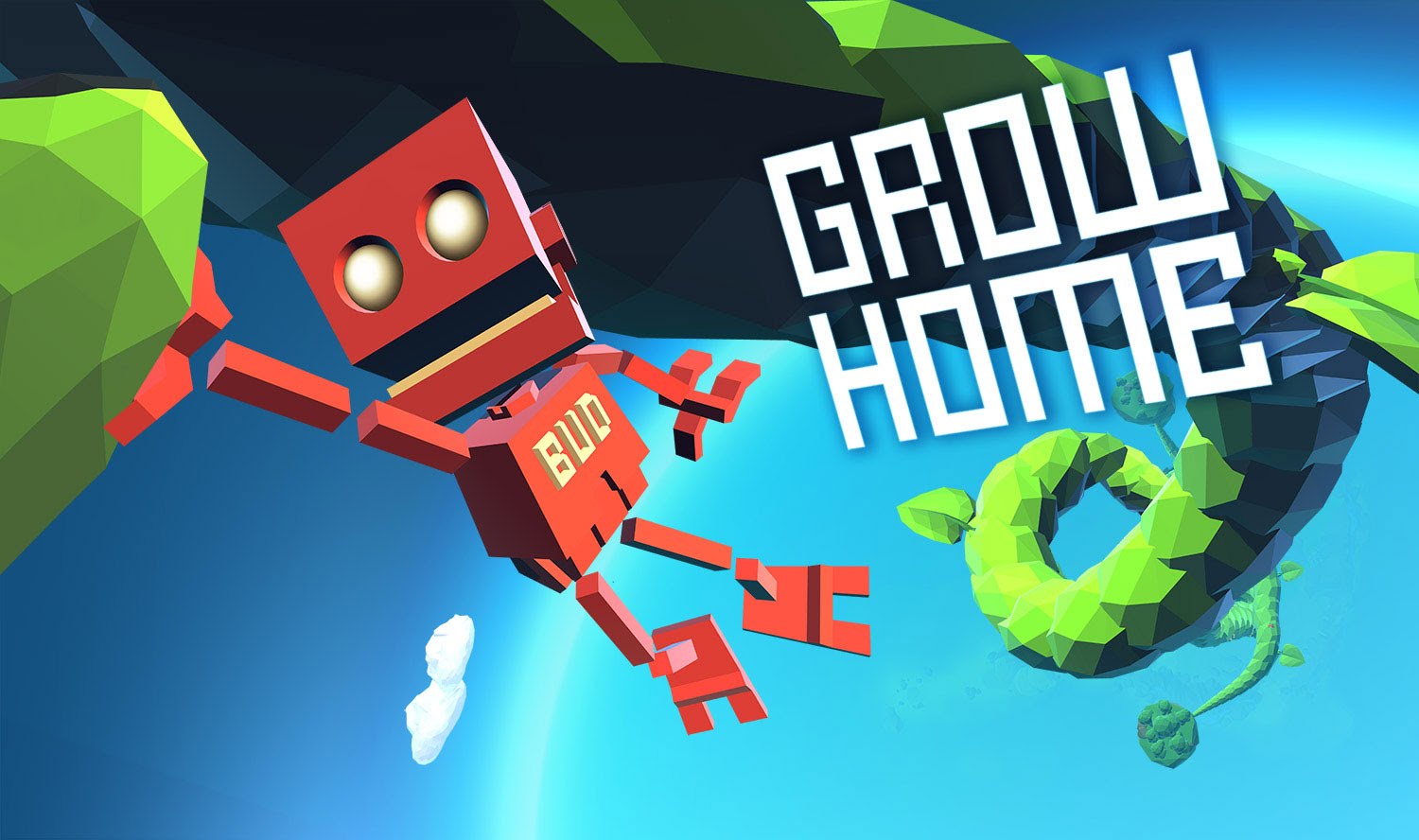
In Grow Home you play as B.U.D., short for botanical utility droid. B.U.D. is a clumsy little robot, moving in awkward sputters and with slow, short jumps. At the start of the game your spaceship’s AI, M.O.M., informs you that you have one task—oxygenate your world. This is accomplished by growing a giant Star Plant you find at the start of the game. Growing the central stalk is simple. B.U.D. must ascend the Star Plant to look for blooms. Grabbing onto those with your little robot causes them to explode with movement and life. Sprouts shoot from the blooms, working their way into the empty sky. You need to corral the outgrowths towards fluorescently illuminated floating geography and embed them deep into the rock face. Each connection you make causes the central stalk to rise, creating new blooms and spring board-like leaves along the way. Once the plant grows to a height of 2000m a flower will bloom, allowing you to harvest the ever-crucial Star Seeds and complete the game.

Growing your Star Plant is a refreshing, meditative experience. Each new bloom is story: the one that just fell short of your intended location, the one with the mind of its own that forced its way downward towards the ocean, and the one that formed a perfect corkscrew. The further you get into the game, the more you can see the impact of your actions. The entire world is rendered at all times, so each new sprout adds to the growing latticework that cuts its way into the sky.
That's a whole lot of stories. With many more to come as you get higher and higher up.
The gameplay in Grow Home can be divided into two main mechanics: platforming and climbing. B.U.D.’s mobility starts simple, limited to jumping and climbing. Working your way up the Star Plant and towards blooms is a waltz of climbing and jumping, to and around leaves and trees and cliffs. A lot of your gameplay revolves around B.U.D.’s grasping mechanic. Each hand can grab onto objects separately. Alternating hand holds allows your robot to climb, which is central in your lengthy ascent. Falling is frequent, at first, as you like B.U.D. work to understand the world you’ve been dropped into. To mitigate frustrations, not only are teleporters scattered throughout the map, but small flowers can be collected and deployed as a  parachute slash glider. Everything synergizes to create a compelling gameplay package that easily carries you throughout the roughly 3-hour completion time.
Climbing will get you where you need to go.
Grow Home is a ferry, escorting the player into a new reality. You are an explorer, the first explorer, of an untouched planet. The world feels hollow, initially, a wide open playground in which B.U.D. will explore. The minimal geology, flora and fauna all have a sense of purpose, though. Everything fits. And the work done by the Ubisoft Reflections team to create a world you want to spend your time in is incredible. Grow Home’s planet is filled with wonderful ambient noises, melodic whistles of winds and the quiet hum of space. The emptiness of the world helps to bolster the resonance of all player actions. Every jump, plant growth, or B.U.D’s little bleeps or bloops echoes loudly—reinforcing once again that you have full ownership of your surroundings. The blankness of your surroundings acts as the perfect canvas. Your exploration is complemented by a soothing soundtrack that was so good I went out and bought it. It creates a perfect background for just about anything.
The empty space is yours to control. 
When I first started my time with Grow Home I really expected to dislike the controls. Aside from the (preposterous) critique that the game was too short, control wonkiness was the second most common complaint among reviewers. For the first 10-15 minutes or so, I thought the reviews were right on the money. Controlling B.U.D. was awkward. He felt slow and floaty, would slip around when trying to run, and often had trouble grasping onto surfaces. As I spent just a bit more time with the game, however, I developed a growing (sorry for the pun) sense of familiarity with the goofy little robot. It clicked. I began to understand his limits, his jump height, how to position his hands to climb lighting fast, how far his jet propulsion could take me, how to counter his momentum when landing after a rapid descent. It worked to create a sense of connection with B.U.D. As he grew in confidence, growing the Star Plant closer to space, so too did I grow in my mastery of his controls. I went from barely being able to jump from platform to platform, to catching and collecting a falling leaf while free falling, only to deploy it to glide comfortably to safety. My growth was exhilarating. Using a unique control scheme do create a bond with your protagonist is a powerful tool unique to games, and on that is painfully underutilized. I’m amazed at how expertly Grow Home executes its inclusion in game.
Video evidence of my skills. I'm basically a secret agent.

Above all, I really enjoyed how much Grow Home respects the player. Grow Home is perfectly simple. A straightforward control scheme embodies the notion of “easy to learn, difficult to master,” one of the best principles in game design. Grow Home’s sandbox gives the players the ability to do whatever they want. Exploration is rewarded, but it's totally optional. The games quiet and contemplative tone can appeal to anyone looking to have an immersive experience into a beautiful world. Small collection quests, like the shimmering crystals or teleporter scans of wildlife, offer completionist gamers an avenue for a more content dense experience. Grow Home can be completed in roughly 3 hours on your first run which, to me, shows a deep respect for the player’s time and attention. It is a perfect, compact experience. Grow Home brings you into a new and interesting world, shows you astounding sights, develops a bond between you and B.U.D., and then leaves you satisfied. Overstay its welcome, Grow Home does not.
Blooming the Star Plant is the end. Or maybe just a new beginning?
Grow Home is a remarkable success, exuding confidence and competence in all aspects. Grow Home is perhaps the biggest surprise of the year in that it delivered something I never knew how much I needed. I still find myself hopping into the game every once in a while, just to be brought back to my first time exploring and filling out it’s great world. Grow Home is a must play, a game I cannot recommend highly enough. Home is where the heart is.

Grow Home
5/5