Friday, July 10, 2015

News & Views
7/4/15-7/10/15

Hello and happy Friday! Welcome to The Impact Factor everyone. I know I haven’t written it much here, but I really appreciate every single one of you who comes to check out my blog. It means a lot. This week has been huge for The Impact Factor, too, as I hit a major milestone in the podcast: 10 episodes! That’s right, I’ve been doing a podcast with my good friend and fellow scientist Charles Fliss for two and a half months now! We talk the week’s most impactful video game news. Check us out on SoundCloud and iTunes!

Got a lot of great stuff on this week’s edition of News & Views. In video game writing this week, I found pieces chronicling the life and work of Shigeru Miyamoto, a love of ambiguous video game endings, video games as cultural agents, and how Batman despite his code does in fact kill people. For all of that and more, check out the stories below!

Spotlight
Cassidee Moser, KillScreen

Worth Reading
Raph Koster, RaphKoster.com

Phill Cameron, Gamasutra

David Sheff, Rolling Stone

Catt Small, Offworld

Rowan Kaiser, Unwinnable

And the rest!
Patrick Klepek, Kotaku
Klepek is a writer whose work is pretty often featured here. I like the guy. Found myself nodding in agreement all throughout this piece. I appreciate ambiguous endings in all kinds of entertainment media, certainly including video games. Sometimes wrapping up a story into a neat little package isn’t the best move, creatively.

Ben Kuchera, Polygon
Kuchera is another repeat guest of The Impact Factor’s News & Views. So sue me. (Please don’t). The relationship between Lee, Kenny and Clementine evokes such powerful emotions. Perhaps none so powerful as the role a parent takes in raising, protecting, and understanding your child. Kuchera touches on how Telltale taps into his emotional core—something those games really excel at. Do yourself a favor: read this article, then play some Telltale games.

Laura Hudson, Slate
I think the summary at the top of Hudson’s scathing review puts it best: ‘Ernest Cline’s Armada is everything wrong with gaming culture wrapped up in one soon-to-be-best-selling novel.’ Listening to members of the games media RAVE about his previous novel ‘Ready Player One’ convinced me to pick up a copy and read it. While certainly a page-turner, Cline’s writing lacked substance and pandered to a nostalgia-fueled “gamer” audience that felt nauseating at times. For those of you who don’t know, I am disgusted with how much nostalgia plays into the games space (discussions, games, etc). ‘Armada’ looks to double down. Blech. Hudon’s review is great. Please read it.

Patrick Klepek, Kotaku
You all know I love the Souls games. I’ve written quite a lot about them: a review for Bloodborne, my top 10 favorite Souls bosses, and I ranked all four Souls games here (Day 1) and here (Day 2). It’s kind of crazy to read that Vaati could be plagiarizing, as he is one of the most prominent figures in the Souls YouTube community. Hard to draw any concrete conclusions, but the evidence is certainly compelling.

Ben Kuchera, Polygon
I’ve been noticing this all throughout the Batman Arkham games, but in Knight it happens all the time. Pretty clear that Batman’s actions are causing people to die, though as Kuchera states, it all happens off screen. This hyper violent Batman doesn’t bother me, but it’s something interesting to think about.

Sam Coster, Gamasutra
Getting through Steam Greelight, from all accounts, is a nightmare. Coster gives an interesting perspective on how, just maybe, their zany and memorable trailer helped them to fight their way through Greenlight in a remarkably short period of time. His game, Crashlands is a game made out of suffering and is probably worth a look. Or two.

Tuesday, July 7, 2015

Why we need handheld consoles (for now)
Article

Abstract: Despite a handheld being the first console I owned, I moved away from handheld gaming in recent years. I rekindled my passion for, and appreciation of, handheld consoles these past few months after devoting some time to the Nintendo 3DS and the PlayStation Vita. Smartphone gaming may appear to be a replacement for gaming on portable consoles, but control limitations and problems with the mobile market have limited the kinds of titles playable on phones. No great solution to either problem has been discovered. For now, handheld consoles fill an important niche in the games space and I hope they can stick around for quite a while longer.

Long car ride companion of choice.
Over years of home console and PC gaming, I developed a perplexing antagonism towards handheld consoles. I felt like I didn’t ‘get’ them anymore. Every time I found myself with a Gameboy in hand, I would just be sitting at home. As usual. Why spend my time with small-scope small-screen games when I could just grab a controller and play Dark Cloud 2 or Ratchet and Clank? Sure, I would grab my sleek glacier Gameboy Advance from time to time to play, especially while on car trips. But the experiences tended to feel insubstantial in comparison to their home console counterparts. I ended up playing less and less handheld games. By college, my DS was used exclusively to play Pokemon. Handheld exclusive titles like The Legend of Zelda: A Link Between Worlds got pushed further and further back, arising in part from this feeling that I had ‘moved past’ handheld consoles.

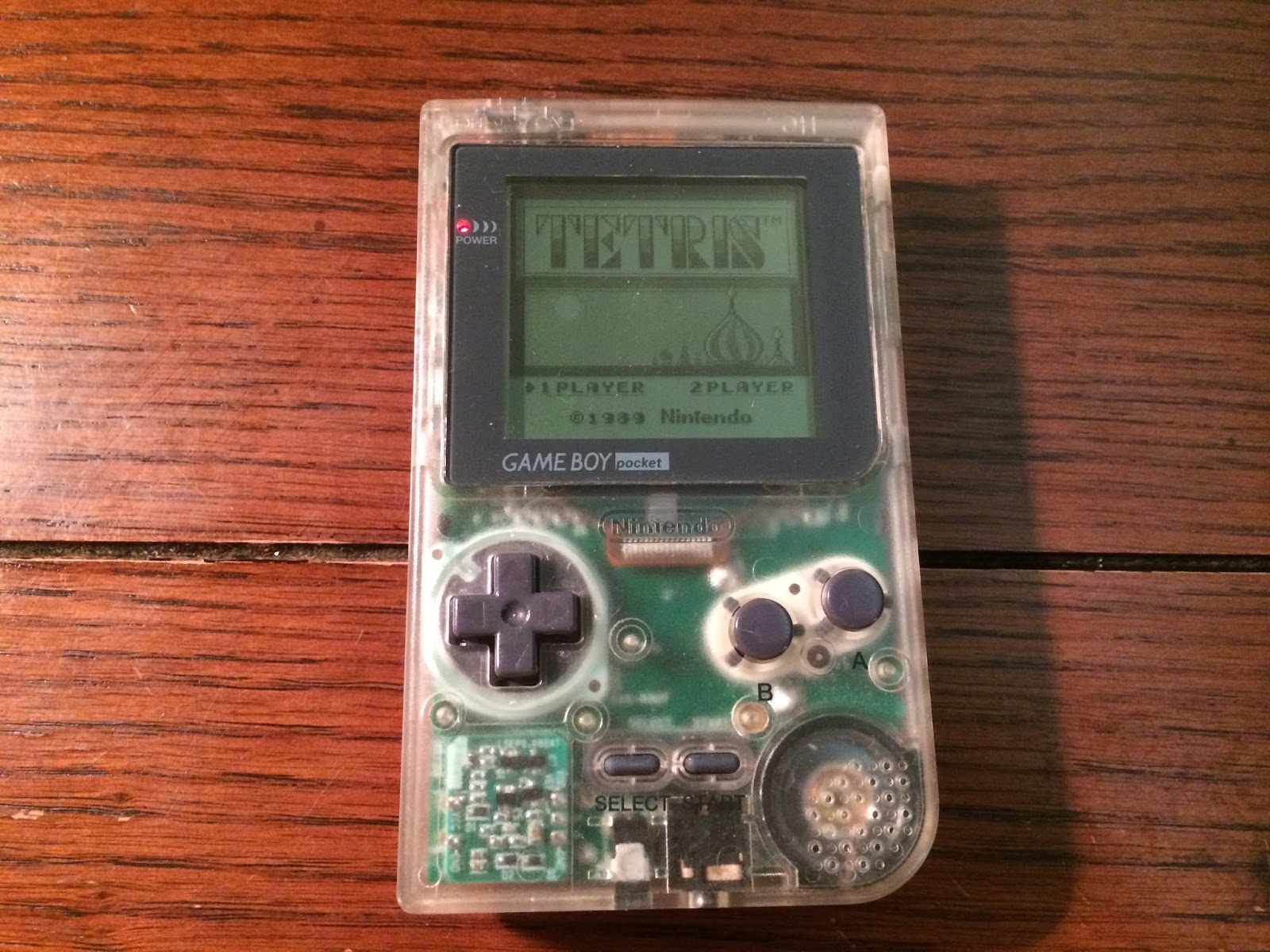
This bummed me out. Want to know why? A handheld was the first gaming console I owned. That’s right. Before a Super Nintendo or PlayStation or anything else, I had the Gameboy Pocket. Boy did I love that thing. I bought into the handheld craze with full stock options: I needed to be able to play wherever I was, whatever time of day. And, of course, I needed to be able to play Pokemon Blue. The Gameboy Pocket never left my side. I played Mario and Tetris and, of course, Pokemon. Then I got the Gameboy Color, the Advance, and the DS. I was fully onboard. But like I wrote above, the time I spent with each got smaller as I got older.
My first console. Uncountably many hours went spent playing on this little thing.
Then I started this blog. I wanted to take in as many games as possible. Justine let me spend some time with her 3DS and I had a blast playing Monster Hunter Ultimate, and I loved when she handed me control of her Animal Crossing New Leaf town or Tomodachi Life island. And then she got me a Vita. Now, whenever I have a quick moment between activities or she wants to surf TV, I can grab my Vita and get a little gaming time in. Handheld consoles have afforded me omnipresent accessibility to substantial games. Handheld consoles fit a niche I didn’t know I existed until I spent some real time with them. But handheld consoles aren’t exactly in the best place right now.
Monster Hunter 4 Ultimate is a massive, phenomenal experience.
I guess I should get around to reviewing it. 
Watching smartphone gaming take up an increasingly large percentage of the market has led me, and may others, to anticipate the impending demise of handhelds like the 3DS or Vita. Each new phone model has faster processors and better graphics cards too, rapidly shrinking the gap between the kinds of experiences you can have on phone versus console. As it stands now, games on the phone can look as great and run as smoothly as pretty much any handheld game out there. Let’s just name a couple. Infinity Blade 3 looks phenomenal—perhaps even as good as PS3 / 360 era games. We’ve gotten gorgeous artistic games like Monument Valley and Framed. Lots of console & PC games have successfully made their way to iOS / Android as well. To name a couple: Valiant Hearts, FTL, Papers Please, VVVVVV, and even newly released games like Her Story. All those games are exceptional. Essentially all were one of the top-rated games the year in which they originally released. Finally, Hearthstone. The game looks and plays great on iPhone, and got a special mention here because it was The Impact Factor's 2014 Game of the Year. So why do we need handheld consoles when smartphone gaming is huge, diverse, and has some the best games you can find anywhere?

Titan Souls is why. Monster Hunter 4 Ultimate is why. Let me explain.

I spent the majority of my roughly five-hour flight to Hawaii playing Titan Souls on the Vita. In Titan Souls you play as a young boy who travels around a lush vacant world to slay diverse and powerful titans with his magical bow and arrow. I spent my time dodging, running and rolling past devastating boss attacks, studying movement and attack patterns, and skillfully landing killing blows on the game’s 18 fearsome titans. Titan Souls is a game that could never be played well on a phone. I’m sure phones are powerful enough to run the game, but one thing they cannot do is create inputs that suit the game’s control scheme. By game standards, Titan Souls has remarkably simple controls. One button is used for running & dodge rolling, and another is used to shoot and recall your arrow. That’s it. Well, aside from one important thing: directional inputs. On Vita, using the directional pad or analog stick moves your character through the gorgeous 2D pixel art world. I have not played a single game on iOS that does directional movement well. Not a one. The most common ‘solution’ to the problem is to create a digital representation of a D-pad or analog stick. This is a poor alternative to its physical counterpart. Not only are the digital controls generally poorly responsive, but they require your fingers to be on the screen at all times, covering up a substantial portion of the game screen. Titan Souls is an unforgiving game: both the player, and titans, die in one hit. I cannot even imagine the frustrations that would arise if I had to rely on a cumbersome digital movement input to navigate its brutal bosses.
There's no way I would try to take on this boss using digital inputs.
He was hard enough already.
Games like Hearthstone or Paper’s Please work so well on smartphones because their control schemes are amenable to touch-based input methods. Your finger acts as a computer mouse, where clicks are taps and moving items around involves dragging your finger across the screen. Titles that are ported to smartphones only succeed when the inputs are designed with a keen focus on making them as easy and unobtrusive as possible. A lot of games can, and have been show to, work in this format. So, so, so many others cannot. Titan Souls and Monster Hunter 4 Ultimate are just two quick examples. I would say, in general, several entire genres cannot work well on phone: first-person shooter/action, third-person shooter/action, platformer (3D especially), and fighting games. Or, as I like to think of it, four of my five favorite ‘styles’ of games. I love Hearthstone as much as anyone (probably more), but I want to be able to play all kinds of experiences on the go. Not just ones in which touch based controls make sense.

An obvious solution would to be develop a sturdy, comfortable, and responsive smartphone accessory that would give access to non touch-based inputs for directional movement and button presses. People have already figured this out, albeit to disappointing results. One solution has been to create game controllers that can pair with the smartphone. An obvious solution, sure, but one that removes some of the simplicity and headache-free portability of the all-in-one handheld consoles like the N3DS or Vita. Others have designed snap on button/stick attachments for smartphones. Not only are these accessories expensive (you’re looking at around $80 minimum), many have also found them to feel flimsy, lack responsiveness, and have poor form factor (ie they’re not comfortable). These issues feel particularly egregious considering how awesome it feels to play with a Vita. My god is that one well-designed handheld.
You're looking at a $100 accessory folks. It's functional, sure, but it's
also bulky, massive, and feels cheap.
Issues arise with the mobile market, too. So many smartphone gamers are unaccustomed to paying for games, content to click around for 10-minutes at a time in one F2P game or another. I paid $15 for Titan Souls and it was $15 well spent. Getting iPhone users to spend even $1.99 is a challenge, as developers of the excellent Threes quickly discovered. So it’s no surprise many games aren’t brought to iOS/Android, again sustaining the necessity of handheld consoles in the contemporary game space.


For the time being, I love my Vita and will continue to spend time with, and appreciate, handheld consoles. The offer much more than may initially meet the eye, and fill a vital niche in my gaming time. They’re a great travel or home companion, bringing game variety that’s unmatched by the smartphone market. So stick around handheld consoles, ok? Good. Time to get Danganronpa Trigger Happy Havoc started up.

Friday, July 3, 2015

News & Views
6/27/15-7/3/15

Darn. Vacations always go by way too fast. I am pretty such I could be a beach bum for another couple weeks, easily. Ah, well. As promised, The Impact Factor never takes a break! I’m back here as always with your weekly dose of video game news & views! Check out below for great pieces about Japan’s culture of fear, what games can learn from kid’s books, how to deal with a highly toxic online community, and why everyone should stop writing rape scenes.

One quick note, for all of you who don’t follow me on Twitter, my vacation will delay the podcast. But only slightly. Instead of Friday (its usual release day) the episode will be up on Sunday! Keep an eye out on my twitter (@alexsamocha) and the places it gets posted each week: SoundCloud, iTunes, and YouTube!

Spotlight
Peter Brown, Gamespot

Worth Reading
Keith Burgun, Polygon

Sidney Fussell, Offworld

Anna Anthropy, Offworld

Alex Hern, The Guardian

Philpp Zupke, Gamasutra

And the rest!
Laura Hudson, Wired
Hudson’s piece about rape is fantastic. Stop including rape scenes. Please. They’re problematic through and through and, as Hudson brilliantly argues, are lazy writing to boot.

David Scammell, Videogamer
It’s sad that this is good news, but good news it is. Battlefield 4 launched with catastrophic problems, functionally broken for a huge percentage of the playerbase. With such a tight deadline for Battlefront’s release (one would assume it needs to be out before the movie in December), it’s good to know EA (at least in word) isn’t going to release a broken game. We’ll just have to wait and see if they deliver on their promises.

Patrick Klepek, Kotaku
At first, I didn’t think I could be all that excited for Dark Souls 3. It marks the third Souls game in as many years. Well, I guess I was wrong. Klepek goes through what he thinks we can expect from the story/world in this ‘final’ installment. Now, I’m back on the hype train. Thanks a lot, Patrick Klepek!

Maddy Myers, Paste
I’ve moved away from more traditional online multiplayer games recently, but I can remember how toxic and verbally abusive online competitive communities can be. It’s not fun. I am so glad games like Hearthstone don’t allow any player-to-player communication. Heroes of the Storm allows one-click muting. I stand by Nintendo not implementing voice chat in Splatoon.

Jamie Madigan, Psychology of Games
What great idea of a website and podcast. Give this episode, Toxic Behavior, a listen. Madigan talks to a community manage for League of Legends, a game known to have one of the most toxic communities out there.

Chris Morris, Fortune
It’s good to see Nintendo finally talk about the Wii U’s failure. After E3 2015 especially, it’s as clear as ever that the console is dead in the water. Miyamoto shares his insights on why he thinks the console did so poorly. I think he’s right, but there are so many other reasons why the console bombed. No big first party games, too high price point and, in my opinion, a confusing and terrible name.

Jamie Madigan, Gamasutra
This is something I’ve been wondering for quite a while. I really enjoyed my time with the Mass Effect series. Mass Effect 2 was phenomenal. Mass Effect 3 was a great game too, ending aside. In some sense I ‘get it’: the whole franchise had been building up to this climax and, in a series where player choices are supposed to have such a substantial impact, discovering the sum of your actions came down to one of three bizarre choices was a bummer. Still. There’s a lot to love about Mass Effect and I’m tentatively excited for the new one.  

Tuesday, June 30, 2015

Couch Co-Op: No Second Controller Required
Article

Abstract: Fewer split- and shared screen co-operative games are released each year. The same holds true for local multiplayer games in general. For my girlfriend, Justine, and I, we needed a new type of co-operative experience to fill the ever widening void: and we have, with shared story games. Played with a single controller, games like Tales from the Borderlands and Heavy Rain provide the two of us equal agency in shaping our time with the game. Straightforward game systems allow the focus to be solely on the characters and story, and have made these shared story games some of our most memorable gaming experiences in the past few years. We have found a new kind of couch co-op, no second controller required.

Couch co-operative video games, played with a single controller, have been some of the most enjoyable gaming experiences I’ve had in the past couple years. Yeah, you read that right. I love playing co-op games using just one controller. How you might ask? That’s what I’m here to tell you.

The release of Telltale’s Tales from the Borderlands’ third episode this past week inspired me to start this piece. Telltale has been knocking it out of the park in the past few years with their excellent The Walking Dead, The Wolf Among Us and yes, Tales from the Borderlands. Telltale takes the foundation upon which many of the adventure games were built, and provides character-driven dramas (and comedies!) that through great dialogue choices and big decisions, allow the player to have sublime agency in how each games’ story is told. In some sense, Telltale games are the truest interpretation of a choose-your-own-adventure book in video game form. I cannot get enough of them. And the best part? I get to share these stories, these crucial dialogue options and game altering decision moments with my girlfriend and partner-in-crime, Justine. That’s what I’ve written about here today.

Let me take a quick step back for a moment. Justine and I love playing all kinds of games together. Some of our favorite experiences have been with loot-based co-operative games, like Diablo 3. We got pretty deep into Diablo. I, as a mage, and her, as a barbarian, kicked ass and took names all throughout the story and a good way into a second playthrough. Another, one of our favorites to date, was the time went spent with Borderlands 2. I played through the first game in the Borderlands series solo, having picked it up on the cheap through some PSN sale. As a fan of RPGs, shooters, and comedy, Borderlands and I instantly clicked. Exploring the chaotic and wonderful Pandora, cracking open loot chests, blowing up skaggs and rakks. All of it worked. But Borderlands was a game that was built from the ground up as a co-op experience and, during my playthrough, I certainly felt it. The second game came at the perfect time, since Justine and I were searching for a game we would play through together. Borderlands 2 allowed the two of us to play through the entire campaign in split-screen. It was fantastic. The two of us sunk easily over 150 hours into the game: we got through two full playthroughs on our main characters, including several of the DLCs, as well as another playthrough with a different set of characters. For two months or so, Borderlands 2 was our evening routine.
Sure, it was kind of hard to see stuff at times, but split-screen Borderlands 2 was an absolute blast.
These two controller co-op experiences are phenomenal. It allowed me to share my time with these great games with someone for whom I care so deeply. Split-screen co-op gaming is something that we haven’t gotten to do so often. And, if trends hold, it will be an increasingly small part of our lives as time goes on. For years now, games that allow this kind of co-op gameplay are growing fewer and fewer in number. With an emphasis on increased graphical fidelity and detail-rich graphics, gaming consoles would buckle under the colossal weight of trying to run two instances of the game at the same time. A game like Borderlands 2 can get away with this because it has stylized cell-shaded graphics. It’s not trying to recapitulate reality or try to cross the uncanny valley. What that means for Justine and I, though, is in any given year we have access to only a small handful of titles to play two-controller co-operatively.

New AAA games generally provide co-op as an online-only mode. If each player has their own copy of the game, on their own system, all the network has to do is throw them together on the same server and they’re good to go. Online co-op is all well and fine, but in my case and I’m sure in many others, it doesn’t perfectly supplant the feeling you have playing together in a shared screen experience. Bungie’s Destiny is a title that really marked the death of split-screen experiences, for me. I was excited for Destiny ever since I first learned of it. What’s not to love about a sci-fi co-op FPS-RPG hybrid from the studio that created Halo? (Unfortunately after having played it, the answer to that question is ‘quite a lot of things,’ but that’s really not the point of this article) As time went on, I got more and more excited to play through Destiny with Justine just like I had with Borderlands 2. Bungie had a long track record of having great split-screen co-op support with their previous titles. So, naively, I expected it to be the same here. In the end, it was not the case. I was not able to play Destiny with Justine. Maybe I would have played it longer if I had. Destiny is just an example of how the games space is changing. I expect to see only fewer split-screen, or even shared screen, co-op experiences in the future.
No local multiplayer? No go. We had been looking forward to it, too. 
I’m certainly not the only one who noticed that games you could play together in-person were slowly fading away. Aside from Nintendo, who continues to produce quality ‘couch multiplayer’ games, so many developers and publishers have moved away from these kinds of experiences in recent years. Recognizing this deficit, and fueled by the creative freedom independent publishing affords them, indie developers have taken over the mantle of local multiplayer experiences. With excellent titles like Sportsfriends, Towerfall Ascension, Nidhogg, & Starwhal (just to name a few of the many), indie devs have pin-pointed what makes local multiplayer games fun and concentrated them into great, compact experiences. And these games are fantastic. Unfortunately, they don’t address the key missing piece for Justine and I. All the above games are competitive in nature. When the two of us want to game together, 9 times out of 10 we would rather work together than compete.
Towerfall Ascension is a lot of fun. Generally though, I'd rather be shooting arrows
with Justine, not at her.
So that left the two of us with a dilemma. If two-player couch co-op experiences are disappearing, and the games that appear to be replacing them emphasize competition rather than co-operation, what are our options? We can we look to for that shared gaming experience? Thankfully, we did not have to look far. We found shared story experiences, or like the title of this article suggests, two player co-op where no second controller is required.

Justine and I have found our niche in these ‘shared story experience games’. I use this vague term because, well, the games we play single controller co-operatively wear a bunch of different hats. Adventure game, point-and-click, cinematic action game, you name it. But what’s shared between these kinds of games is what’s important—and that is this powerful feeling of agency, where our moment to moment decisions are the main driving force behind how the game progresses. We first discovered how much we enjoyed this single controller co-op experience with Telltale’s The Walking Dead Season 1. Playing through The Walking Dead was phenomenal: the two of us jointly decided to make the tough dialogue decisions, game changing scenario choices, and puzzle solving. Throughout our entire playthrough the two of us are talking, whether it be what to do next, whether the choice we made was best, or what we think of the characters’ motivations. After having such a wonderful time, we wanted more. And we found that with more Telltale games: The Wolf Among Us, The Walking Dead S2, Game of Thrones, and Tales from the Borderlands. Pretty much everything Telltale has put out lately. But even after all those, we still searched for more experiences that gave us that co-op feeling. We found and enjoyed David Cage’s PS3 outings: Heavy Rain and Beyond: Two Souls. What we love most about these games, whether they are from Telltale or Quantic Dream or any other developer, is that no matter which of us is holding the controller both Justine and I feel like we have an equal hand in shaping our playthrough. Our decisions and our teamwork are the game, less so the button presses or game systems.
You can bet that Justine and I were torn over the many tough decisions
we made in The Walking Dead.
Games like The Walking Dead and Heavy Rain are often criticized because they are just QTE (quick time event) fests. Some bemoan that those kind of games have “no gameplay.” I have a feeling that those people don’t understand what these titles are trying to accomplish, frankly. The absence of more involved or ‘standard’ game systems allows these games to focus on story and characters.  Of the many games I’ve played, The Walking Dead and Heavy Rain have stories that have stayed with me far longer than so many others. And that’s due in large part to how the ‘simple’ gameplay systems emphasize dialogue, characters and story. Often, extra game systems detract from a cohesive and memorable story. Just to give a quick example: I love Final Fantasy 6. But even today, I can only remember bits and pieces of the story. All the time I spent outside of story quests, battling monsters or flying around the overworld or doing side quests, dilutes the narrative. This isn’t a bad thing at all. It works so well for so many games. But for something like The Walking Dead, where Telltale clearly put so much work into creating an interesting story with compelling characters, it wants, almost demands, you remember it. The gameplay reinforces this idea. Aside from maybe wanting another puzzle or two, I wouldn’t have it any other way.
Heavy Rain and shared story games are so much more than the sum of their gameplay.

Shared story experiences, a.k.a. single controller co-op games, were our solution to a growing problem. Games like Tales from the Borderlands have allowed Justine & I to have more to play together. They also let us tell these fun, hand-crafted stories that are unlike anything we have played before. Are we excited for more two-controller co-op experiences? You bet. Battleborne is one of our most anticipated games this fall (if early information is correct and we will be able to play split-screen). But we’re also excited to have more shared story experiences we can play together as a team. Because we’re a team. The next episode of Tales from the Borderlands cannot come soon enough!
Onwards to our single controller co-op filled future!