Tuesday, March 10, 2015

Game Developers Conference 2015: A Reflection (& Pictures!)
Special Feature

Abstract: GDC 2015 is a meeting filled with vibrant new ideas, excited game developers, and a well-honed focus on the games industry: whether it is getting your start, refining your work, or a glimpse into the future of video games. As the first video game conference I have ever attended, I was overwhelmed with the scale of the event and the talent of those present, both exhibitors and attendees. The show floor was filled with great games and experiences. I used my one-day student pass predominantly to get a glimpse into what it takes to break into the games industry. I left feeling a fuller appreciation of the current duality of beginning your career in video games. One on hand, increasingly rigorous academic training is creating a new generation of highly skilled game artists, designers and programmers well qualified for work following graduation from college. On the other, the widespread availability of game making tools and collaborative game making projects (game jams) gives those without formal training an avenue to break into the industry. For someone like myself, I have a long way to go if I ever hope to work in video games, but at least the path to doing so is clearer now than it has ever been.

I have wanted to attend a video game conference for the longest time. I watch events like the Electronic Entertainment Expo (E3) and Gamescom with a jealous eye, wishing that I were there to experience the new games in person and speak with developers. Attending a meaningful conference is easier now than it has ever been with the advent of Penny Arcade Expos (PAX), where open access to the public allows anyone to get real face time with developers and industry veterans. And then you have the Game Developers Conference (GDC). GDC is the world’s largest and longest running professionals-only game industry event. While E3, Gamescom, and even PAX to a lesser extent, are marketing heavy trade shows, GDC is more focused on game makers coming together to share ideas, grow networks, and present the future of games.

GDC is replete with informational sessions. In these, lecturers speak about the principles of production, programming, visual arts, management and more. These talks really reminded me of the scientific meetings I have attended, where speakers share their findings and help to grow the core knowledge of the community as a whole. The conference featured two separate show floors. The expo floor features hands-on kiosks for upcoming games, like other conferences. The emphasis here is not necessarily on the new games, though, but more so on the new technologies, services, and innovations that are moving games forward. For instance, this year’s show floor was filled to the brim with virtual reality (VR) exhibits, supplemental VR technology (like haptic feedback-based controllers), and new support services for an increasingly mobile game rich industry. The second show floor features GDC’s Career Center. GDC itself compiles a list of hiring companies and the jobs they have available. Indeed, the Career Center expo area is a self-contained job fair, where publishers, developers and companies alike are looking for new talent. GDC’s ‘professionals-only’ mindset creates an intense career-oriented conference dynamic. Attendees carry around copies of their resume, giving it out to anyone receptive. Business cards are a must, as nearly every conversation I witnessed resulted in their exchange. And this is well-understood: people attend GDC to grow their network, gain new friends and colleagues, learn from their peers, and potentially set up future collaborative projects or jobs.

To that extent, I was a very much a fish out of water. As you all (probably) know, I am a biomedical sciences Ph.D. candidate. I was able to attend GDC through my label as a student, though perhaps not the kind of student the organizers intended. I attended, first a foremost, to gain insight into the work I would have to do if I ever hoped to work in video games. Secondarily to see all the cool new games and technology on display. Because of this, however, initiating a network for myself was difficult. Once the attendees (and exhibitors) learned of my current work as a science Ph.D., many of the conversations quickly died off. I have no experience in coding a game, creating a design document, or any real games portfolio to speak of whatsoever. Attendees are mainly looking peers to help hone skills with, and jobs. Exhibitors are looking for skilled game makers. I offered none of the above. Still, conversations about games themselves were great, and many were interested in why I was thinking about working in games. Every time I was left in awe, too. So many young people have already made a handful of games, have coded in several game engines, been a part of game jams, and more. The talent that surrounded me at GDC was astounding, and I loved being a part of what was (and was not) on display.

It was clearly “too early” for me to attend GDC for the reasons the majority of people do, early-to-mid stage career development. But that was never my intention. I wanted to learn about what working in the industry was like and the skills I would need to gain in order to do so. To that extent, I attended a ton of seminars. To cite a couple:
                        “A New R&D Process for Game Design”
                        “From Student to Designer/Writer”
“Ten Tips for Successful Game Industry Interviews”
                        “Internships, Bridging the Gap”
These talks were great. I will not go into any great detail, but I learned key takeaways about portfolio creation, what to say and what not to say at an interview, and how to assess the worth of an internship. Here again, the games industry has so many parallels with the life sciences. Perhaps the best example was at the talk in which I learned about “PlayStation University,” a 12-week internship program that almost point-for-point matched the objectives and design of the two research science internship programs I participated in prior to my acceptance into graduate school. It is a great way to hone your skills and understand what goes into that career, so it was neat to see a big name in games adopting this successful model. I was happy I attended the sessions I did, because it allowed me to refine my understanding of working in video games. I enabled me clearer tools self-assessment, perhaps even brutally so, while simultaneously giving me a clearer picture of what work lies ahead of me should I chose to pursue that path. Like all career exploration, I was first met with a huge wave of anxiety that, following synthesis and reflection, became more manageable. Ultimately, I need to focus on narrowing down potential careers to pursue, and get experience via game jams and independent projects.

One quick aside, and key takeaway, is the emerging duality in game makers. I had known about this for a while, but it was educational getting to see it at its beating heart. The landscape of academic training for games is rapidly growing. Programs now span the country, even at top tier schools like the University of Chicago, that focus on game design and game-specific coding & programming. This is creating highly trained, highly skilled students with rich portfolios derived from a combination of class projects and game jams with friends. When looking at games from this perspective, it is going to be increasingly hard for non-trained individuals to find a job in video game creation—the pool is just that much more competitive. On the polar opposite side of the spectrum is this new age of self-taught, fully independent game makers. Great game creation tools now exist for anyone to download, like Stencyl and GameMaker. Following the huge announcements at GDC, Unreal, Unity, and Source 2 engines are all free to people to use as well. Great written and video tutorials exist for many of these engines, allowing nearly anyone with passion and time to create games. Again, this makes getting hired by a company or studio even harder, since the pool of applicants is larger now than it ever has been. This duality has made for an innovative, and interesting, past decade for games, and will continue to have substantial impacts on the industry for years (perhaps decades) to come.

The main expo floor allowed me to put all those thoughts aside and just be surrounded by fantastic new games and experiences. I spent time in the Xbox area playing Gigantic, and at PlayStation’s playing Axiom Verge, Titan Souls, Amplitude and Guns Up. I got to check out the Independent Game Festival (IGF) pavilion that had on display a great selection of lauded indie games. There, I was able to play some Killer Queen, Invisible, Inc., and This War of Mine. There was also this fantastic section of the show floor called alt.ctrl.GDC that featured innovative new experiences in gaming. I was able to get hands on with the unexpected darling of GDC, Butt Sniffin Pugs, and another game in which you use vibrating controllers in a battlebot-like arena. Hands-on experiences with virtual reality were either by appointment only or several hour long waiting lines, so I was not able to try out Project Morpheus, Oculus Rift, or Vive. Still, VR demos were everywhere and it was interesting to see people trying them out. Everything I saw and played was a blast, and made me even more excited about the future of games.

And that’s it for the meatier side of my reflection. I have put a bunch of my pictures from the event below for you all to enjoy! I look forward to attending more video game conferences in the future. GDC was a great learning experience and was a joy to attend. Maybe next time I attend I’ll have more to bring to the table!

My early morning walk towards the convention
center!


GDC had this great video game history museum. I didn't get to play, but it was fun to walk around
and see the memorabilia and classic arcade cabinets.
So early the main expo floor was not even open. Gave me some time for pictures!


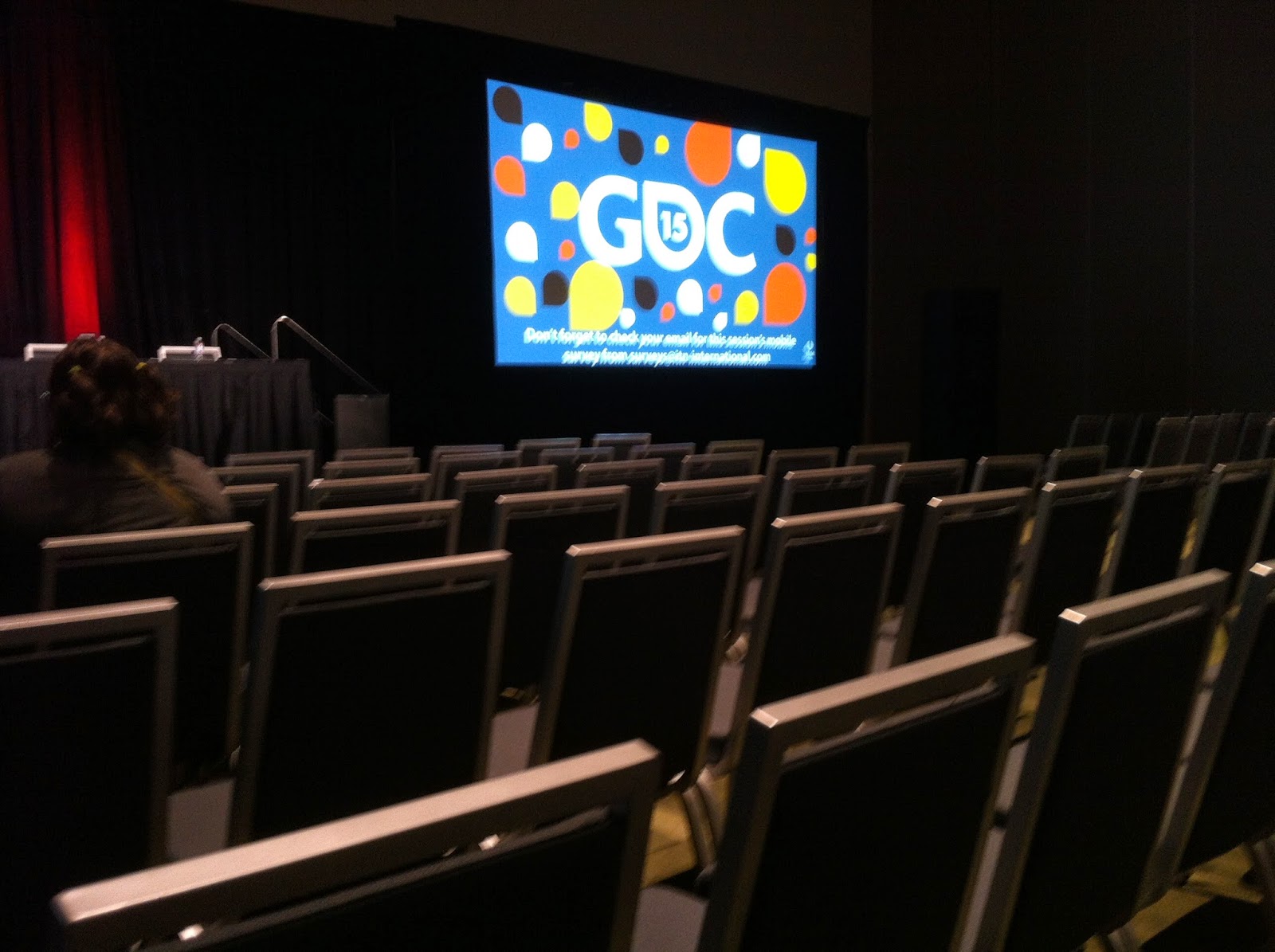
Waiting for my first talk of the morning. It explored a new direction for the R&D
process in game design. 


The XBox area has a lot of gaming setups. I didn't get a closer picture, but I was able
to get my hands on Gigantic, the new MOBA-like gaming coming to Xbox One & Windows 10.
I enjoyed what I played! 
My first look at the PlayStation area!
There was this neat patterning in the back of the PlayStation exhibition.
I grew up with Sony consoles, so seeing this definitely triggered my inner fandom.
Been excited about Axiom Verge for some time. Getting hands on confirmed for me
that I will definitely be picking up this neat Metroidvania on 3/31.
Described as a synthesis of Shadow of the Colossus with the punishing difficulty
of Dark Souls, the moment I heard about this game I was sold. Hands on
gave me confirmation of its brutal difficulty and great boss fights.
Amplitude is a remake of the cult PS2 hit of the same name. The rhythm
based gameplay worked well and looked beautiful.
I really wanted to get my hands on Bloodborne, one of my most anticipated
titles of 2015. The line was always too long for my taste, though. Everything
looked superb and once again re-ignited my fervor for Souls games.
VR was huge at GDC. Here is the entrance to Facebook/Oculus's display area.
Lines to get in were insane, but here is a eerie picture looking into the display
 Demoers are strapped into the Rift and Gear VR. Gives me strange Sci-Fi vibes!
There was a lot of VR accessory tech, too. It might be hard to see here, but this guy
was wearing low-friction shoes on this plastic peripheral. By moving his legs
like he was walking, his virtual character moved as well.
Star Wars VR demo. The participant held a stick-shaped accessory in each hand.
The game played out like Luke in the original trilogy, blocking laser shots
from a floating drone. 
There were huge booths for Unity and Unreal, both of which went free following
announcements at GDC. I witnessed tutorial seminars at each booth, again emphasizing
this education / career development aspect of the conference.
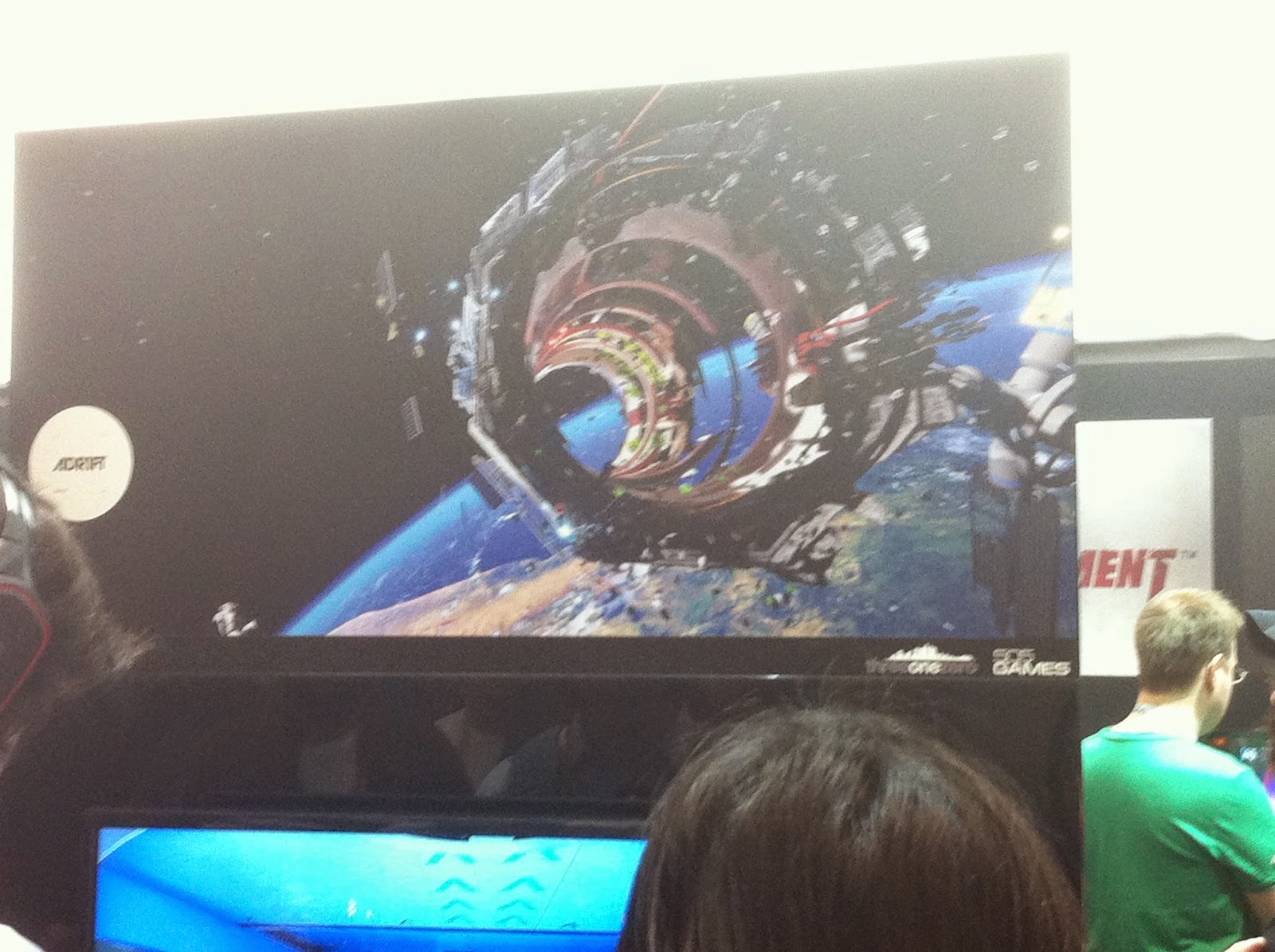
A game that really stood out for me was Adr1ft. You play as an astronaut on a massively damaged derelict
space station trying to find your way through the precarious debris to escape. The visuals were
gorgeous and totally immersive.
Butt Sniffing Pugs was a surprise darling of the show. Its innovative control scheme
coupled with its adorable aesthetic made it an easy game to like. I loved the description
of the game from the creators, pictured below

The IGF pavilion featured a bunch of indie games that were nominated for awards. Because
I attended on Friday, many booths were shut down, but I still got to play games like Killer Queen,
This War of Mine, The Talos Principle and This War of Mine.
Conference over! I got to see a ton of things at my first GDC, and learned even more.

Friday, March 6, 2015

News & Views
2/27/15-3/6/15

Video game season is starting to hit its stride! With GDC this week, and PAX East this weekend, a lot of stuff is happening gaming world. The biggest news coming out of GDC is virtual reality, and Valve’s foray into this increasingly competitive space. The breadth of gaming seems to be ever expanding, as several game engines were announced to be going free! This week I’ve put together a bunch of little things, from highlights at GDC to some great articles about the pricing of new games, tales of old games, and cultural divides. Enjoy!

Spotlight
Claude Smith, Niche Gamer

Worth Reading
Laura Hudson, Slate

Samantha Blackmon, Samanthablackmon.net

Paul Tassi, Forbes

Kirk Hamilton, Kotaku

Colin Campbell, Polygon

And the rest!
Mitch Dyer, IGN
Written contemporarily with Spec Ops: The Line’s 2012 release, Dyer unpacks some of the thoughts and work that went into the game’s fantastic story. You can read my review of the game here.

Making Unreal engine free for any developer is huge news, and could change the gaming landscape. Unreal, Unity, and Source 2 all were announced to be free at GDC this year, and mark a promising chapter in game development.

Gavin Craig, Kill Screen
Craig gives a nice perspective into the era of video game mascots, and how that time has long since passed. Crash was my mascot of choice, and it’s sad to see him dead and gone.

Sal Romano, Gematsu
Telltale has been doing great work these past couple of years, so I am excited to see what some former devs can put together. From what I have seen so far, Oxenfree is worth keeping an eye out for.

Lauren Preston, Gamasutra
Preston concisely summarizes the major design lessons learned by Schafer and team when making Grim Fandango, as described in the remastered version’s developer commentary. You can see my review for Grim Fandango Remastered here.

Nicole Lee, Engadget
Virtual reality seems here to stay. We have some exciting times ahead as Valve (Vive), Sony (Project Morpheus) Microsoft (Hololens) and Oculus Rift all compete for the same market. With Valve being the first to announce a consumer product release window (end of 2015), the race is on to see who wins the VR war.

Danielle Riendeau, Polygon
Leigh Alexander and Laura Hudson are teaming up to helm Offworld, and I love that the site is emphasizing diverse game writing from two individuals with such a tremendous track record. I am very much looking forward to the March 9th launch.

Derek Sakamoto, Blizzard, GDC
There have been a lot of great talks at this year’s GDC. Sakamoto gives a fascinating look into UI design for Hearthstone, a game that relies so strongly on excellent user interface. Sakamoto instills some great design principles and presents limitations to every design choice.


And my rank for the February season of ranked play in Hearthstone! Not too bad considering I didn’t play for the last week and a half.

Tuesday, March 3, 2015

Battling the Pantheon
Review
Apotheon, Alientrap Games (PS4)


Abstract: Apotheon, created by Alientrap Games and released on PS4, is a mixed bag. Gorgeous visuals, unlike anything I have ever seen in a game, make Apotheon a sight to behold every second you are playing the game. The sweeping orchestral score and deep knowledge of Greek mythology synergize to create an immersive foray into a war on Mt. Olympus. Presentation isn’t everything though. Apotheon’s gameplay falls flat. A bizarre control scheme and floaty physics make Apotheon unintuitive to play and, often times, unenjoyable. An unevenness prevails throughout Alientraps’ 2D brawler, where high highs are met with equally low lows. Apotheon’s unique artistic styling makes it worth checking it out, but some serious faults cannot be overlooked.

Apotheon is a game I had my eye on for quite some time. Around the summer of last year (2014), PlayStation Blog put together this huge list of independent (indie) games coming to PS4 in 2015 and beyond. Each title had its own post, detailing what the game had to offer. Dozens of titles were previewed and, inevitably, I was curious which of the games would stick with me over the course of the year. Apotheon was certainly one of them. The gorgeous art style of the game alone had me interested enough to habitually check in on its tentative release. The early trailers for Apotheon also hinted at a potential “Metroidvania” style of gameplay, which is a genre / style of game that often resonates with me. As 2015 rolled around Apotheon’s release date was set for the first week of February, ushering in rampant speculation that it may be included as a “free” title in that month’s PlayStation Plus lineup. Thankfully, the rumors were true, and I was able to pick up Apotheon without reservation. Which brings me to today, the review.

Created by Lee Vermeulen and the team at Alientrap Games, Apotheon is a 2D sidescrolling action game with Metroidvania influences. Apotheon’s story retreads the fairly well wrought trope of gods versus man. Due to an increasing lack of respect for the authority of Olympus, Zeus and many of the Grecian pantheon have turned their back on humanity, leaving the world in the state of total chaos. The sky is dark because Apollo will not bring the sun, the seas are flooding the cities and earthquakes run rampant because of Poseidon’s wrath, etc. You play as Nikandreos, a Grecian hero who, with the help of his Olympian ally Hera, seeks to take revenge on the petty gods and save the Earth from total annihilation. Vermeulen’s selection of Hera as your ally was unexpected and refreshing, as her desire to help you comes nearly entirely from a place of disdain for her boisterous, philandering husband (Zeus) and less so because “you are the hero of legend” or something similarly trite. Over the course of the game, you combat the deities of Olympus to gain their power and overthrow the tyrannical Zeus. The formula works for Apotheon, and certainly evokes some of the same feelings I got while playing through the God of War series. That said, Apotheon does not do anything new or exciting with the story, making it mostly forgettable by the time you finish the roughly 10-hour experience.

Apotheon’s crowing achievement is its art direction, which is immediately apparent. To be as concise as possible: Apotheon is beautiful. The game is styled to look like paintings found on Grecian urns from antiquity, with their stark black and white coloring used to depict heroes and stories, set against the warm tawny-hued clay. Every single moment in Apotheon resembles one of these urn paintings, and does so tastefully. At the same time, Apotheon is not afraid to depict locations and monsters of its own making that feel completely at home in the aesthetic. The art is consistent and evocative. I found myself stopping to admire each new location, character, and monster because of how skillfully and interestingly they had been rendered into Apotheon’s art style. The fact that, even in motion (i.e. during gameplay), Apotheon looks this great is no small achievement.

Looking really good there, Apotheon.

“Sumptuous” is a word that comes to mind when trying to think about Apotheon’s art—playing the game is certainly a feast for the eyes. No feast would be complete without the side dishes, and thankfully Apotheon delivers an impressive final package. A great soundtrack compliments the gorgeous art, and works synergistically to create that cinematic and “epic” feel you would expect from a clash against the Olympian gods. The voice acting in the game particularly impressed me, too. Many indie games forgo voice acting in favor of text boxes, for artistic and, likely, budgetary reasons. But Apotheon features voices for essentially every god, each evoking their distinct personalities. Voice acting is a small touch, but one that had a substantial impact while playing through the game. All of these things, the art, the music, the voice acting, come together to create a unique, and thoroughly impressive, presentation.


When playing Apotheon, it is clear that Vermeulen and Alientrap have a passion for stories from Greek antiquity. Though I would never claim to be an expert, I am relatively familiar with the stories and goings-on in the world of the ancient Greek gods. I have read the Illiad, Aeneid, and Metamorphoses and took a decent handful of classes in college about Greek & Roman mythology. All of this is preface to say that Apotheon’s depiction of the Olympian gods is probably the closest to their literary depiction as I have seen in any video game. Apotheon nails their personalities: Athena is cunning and loves puzzling the player, Apollo is self-obsessed and lords his control of the sun over humanity, and the list goes on. There is also a subtly by which the personalities of the gods are brought to bear: no god greets the player like, “Tremble before me Nikandreos, for I am the goddess of the hunt and fertility!” Well, except maybe Ares. But that fits too. Each god you encounter has his or her own zone in the game. These carefully crafted areas are again reflective of the gods themselves, and give Apotheon a great variety of locations to explore. Within these zones are the challenges each god forces upon you and, for the most part, these too succeed in feeling true to the gods they represent and keep the game varied. Apotheon also contains loads of small nods to some of the lesser-known tales from Greek mythology, like that of Actaeon and Persphone. Finally, stone tablets scattered throughout Apotheon contain quotes from Homer, Virgil and Ovid, contextualizing the area you are in or the actions of the gods. I appreciated the respect Vermeulen and team showed for these texts, and I love that people playing Apotheon could potentially be seeing these words for the first time. Through and through Apotheon shows a deep respect and knowledge of Greek mythology, and the game is much stronger for it.

When it comes to the actual gameplay, however, Apotheon is a thoroughly uneven experience. The gaming press’ insistence on labeling Apotheon as a Metroidvania does the game a disservice. Many design elements are shared between Apotheon and that style of game, such as the 2D exploration and ability acquisition. What Apotheon really lacks, that makes a game a Metroidvania, is using new powers for exploration. This model of beating a boss, gaining a new power and then being able to explore previously locked off areas is essential to Metroidvania’s, and gives the player a clear and rewarding sense of progression. By the end of your typical Metroidvania (Super Metroid, Castlevania: Symphony of the Night, Guacamelee!), you feel powerful and have explored every nook and cranny of the world. In Apotheon, beating bosses always results in one of two outcomes: some stat boost or combat ability. In every instance these bonuses do not affect the ability of the player to explore. Often these power-ups are so subtle that I hardly noticed any difference after obtaining them. This design choice eliminates the free and organic sense of progression, reducing it to a linear “beat this god, beat this god…beat the game” model. Exploration is nice, but the game gives the player only limited rewards for doing so. It is not a bad player progression model per se, but for me, it was less satisfying. Apotheon shares more DNA with old school arcade beat ‘em ups like Golden Axe than with Super Metroid in many ways. Apotheon’s core is a 2D brawler; once I had the proper frame of mind, it allowed me to ditch some of my loftier Metroidvania expectations.
 
You have a lot of combat options in Apotheon. I just wish they felt better to use.
Excellent combat is essential to any 2D brawler—it has to be fun and fluid to keep you engaged. Apotheon’s main focus, from a gameplay perspective, it is combat. Unfortunately, Apotheon’s unevenness is at its most evident when considering the combat. Fighting enemies is clunky, slow, and not terribly fun. A lot of this stems from the unusual control scheme in the game and Alientrap’s focus on creating precision-based 2D combat. To attack an enemy in Apotheon you have two options: to attack them directly with your weapon or to use ranged weapons. Each of these attacks can be aimed by use of the right analog stick on PS4, moving the attack up or down accordingly. This is important, as many enemies have shield that can block direct attacks or weak points that demand a precise strike. This control system is awkward to execute, since you constantly have to move your right hand between the face buttons and the right stick. Having to move your hand around slows down the combat substantially and removes most, if not all, of the fluidity. More often than not, I would forgo aiming my weapon because it felt so unnatural to perform. Ultimately, it feels like are stuck between a rock and a hard place: if you try to play precisely, the game feels and plays badly, and if you let the game aim for you, combat turns into a monotonous mash fest. Apotheons combat problems are accentuated by its floaty and slow movement systems. This makes both the platforming and combat in Apotheon feel clunky and imprecise. It’s not all bad, though. The combat still can be quite fun during one on one encounters because of this more slow paced design. I also really enjoyed the item degradation system, which forces the player to switch between weapons frequently. Some of this is made moot by the frequency by which you acquire new weapons, but overall I enjoyed how the idea played out. Lastly, weapons felt unique, especially the rare weapons you could find throughout the world. The flaming sword was a particular favorite.

The same characteristic unevenness is prevalent in the world design. As I mentioned, each god has his or her own specific zone. Some of these areas are great: Hades’ underworld looks and plays great, and I really enjoyed the forest of Artemis. The boss fight against Artemis is a particular standout. The fight made you rethink how you played the game and had a nice thematic twist. Other areas are less successful. I loved the design and progression in Athena’s zone. The rotating labyrinth filled with puzzle and skill challenges was a perfect fit for Athena’s personality and was truly spectacular to behold. However, while the ideas in her area were great, the controls made getting through it a nightmare. In several instances you had to precisely shoot arrows across the map and, given how clunky the controls are, what resulted was frustrating trial and error. Many of the remaining areas had good ideas but were plagued with equally as many missteps. I enjoyed the oceanic feel and the attempted sea map based exploration in Poseidon’s zone, but getting around was a chore and the boss fight at the end was terrible. The final area in the game, commanded by Zeus, was perhaps the weakest in the game and ended up feeling incomplete.
 
Athena's zone map. A perfect fit for the goddess, but getting through it
was frustrating in all the wrong ways.
Apotheon is a game I wish I enjoyed playing as much as I did looking at. Frustrating controls and combat that ranged from boring to infuriating hindered my full enjoyment of the final experience. Still, Apotheon has a lot going for it, and is worth checking out if you’re into Greek mythology or 2D action games.

Apotheon

3/5